
The irony of JD Vance suggesting Britain is in the grip of cultural decline then holidaying in the Cotswolds was not lost on the natives who protested his presence, or the staff who refused to serve him at an up-market pub. Given the state of the USA at present, with its rapidly receding soft power, one might suggest he looks closer to home for cultural collapse.
It seems that, much to the surprise of the ill-educated VP, the Cotswolds is not an England of Mary Poppins and country cottages, frozen in aspic. In fact, the Brits have never been like that, except for gullible tourists. Behind a facade of tranquility, we’ve always been a pretty feisty lot when we need to be.
We also have a history of absorbing diversity. Just study the archaeology of the London, that Rome founded, or the tens of thousands of Huguenots who fled to Britain. They were not just sheltered here, but played a significant role in our commercial and cultural development. The diversity we find in London’s cuisine today is just another indicator. Trump’s relentless attacks on London’s Mayor rails at this diversity success story with barely concealed racism.
There is now a racially motivated right wing MAGA movement in the USA. This is an old story, and it never ends well.
It is no different in essence to every other racially motivated project that sought ill-conceived racial ‘purity’ over diversity. The list is a long one, and in no particular order: genocide in the Balkans; Apartheid in South Africa; Hindutva in India; the Holocaust/Shoah in Nazi Germany; and the ethnic cleansing perpetuated across the empires of Britain and other European powers.
Interestingly, exploitation of indigenous land and peoples, with its attendant extractivism and racism, has often been linked to climate change and continues to be so [1].
Eugenics was so popular in Britain that both the left and right promoted it. Francis Galton was not alone. As Adam Rutherford documents in his book Control: The Dark History and Troubling Present of Eugenics, many of our best known cultural figures were supporters. It was establishment thinking for the likes of H G Wells, Winston Churchill, George Bernard Shaw, Marie Stopes, and more.
They based their erroneous beliefs in part on a simplistic hereditarian mindset, which is perpetuated in how we’ve been taught eye colour genetics in school [2]. Some Eugenicists proposed genocide while others proposed ‘humane’ sterilisation. We are ignorant of this history because we choose not to face it.
The need for identity is a strong pull factor in all of us, so erroneous genetic beliefs persist in apparently benign forms, turbocharged by those DNA services that might tell you that you are 10% nordic. “Phew, I made it”, I hear some poor MAGA convert announce.
All nonsense, but almost everyone plays the game “your paintings are really good but then there have always been great artists in the family”, I am told. Nope! I had an interest in art and worked very hard to develop my practice; no freebies [3].
The desire for identity can so easily turn toxic, and it seems the US Administration under Donald Trump now equates diversity with cultural collapse.
David McWilliams shows in his book Money: A Story of Humanity, that diversity is always the route to greater prosperity. He gives many examples but the rich diversity of Norman Sicily is perhaps the most impressive of all.
We can learn much from nature in this regard, because nature abhors monocultures. It withers amongst the neatly trimmed lawns and acres of hard standing in America’s suburbia, where nature is curated almost to extinction.
Nature flourishes in messy diversity, as in a coral reef. Human societies and cultures do too.
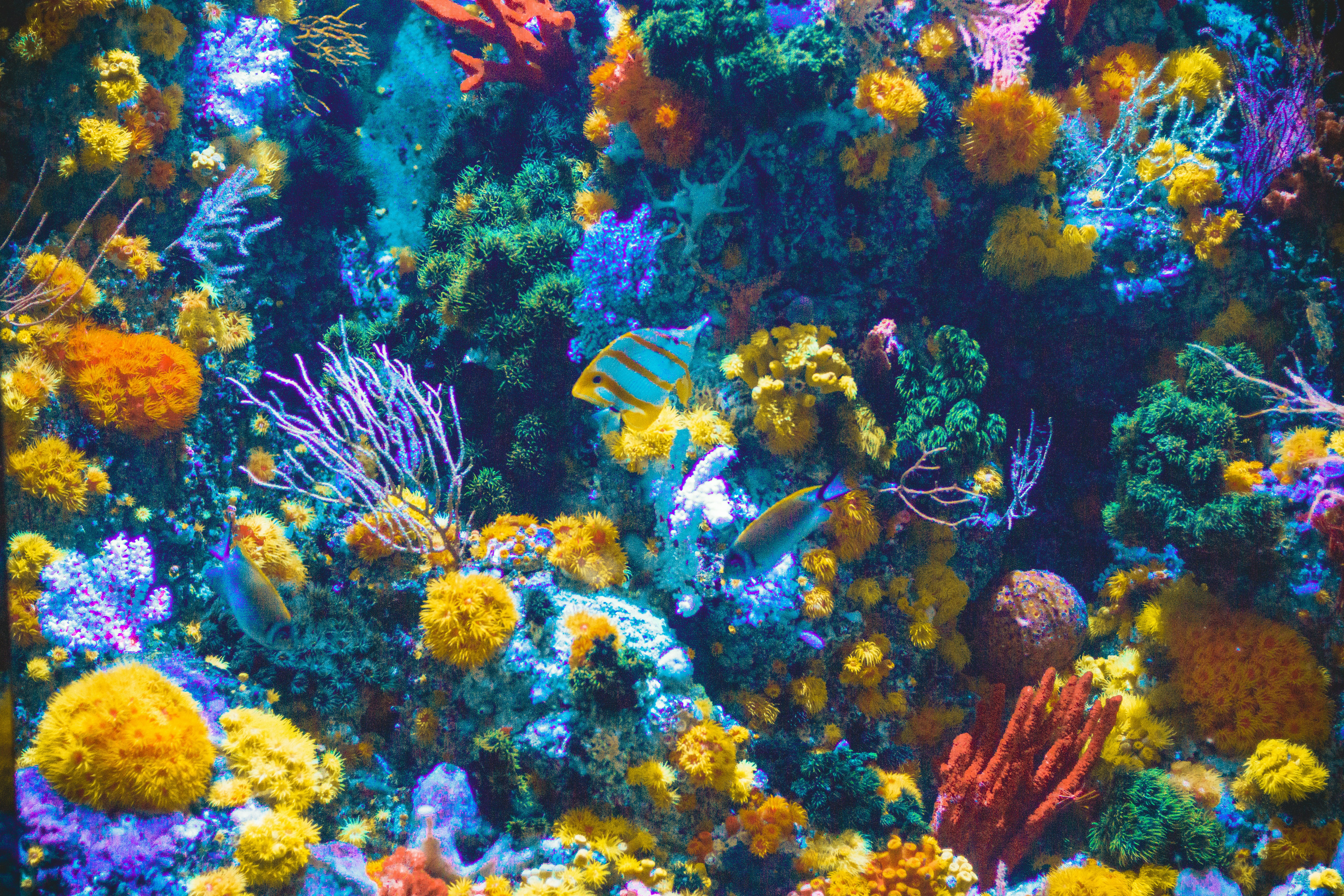
Photo by Shaun Low on Unsplash
So, let’s end our simplistic hereditarian mindset for good, and embrace the diversity that always has, and always will, enrich our lives culturally, commercially and in our communities.
© Richard W. Erskine, 2026
Notes
- The European colonisation of the Americas killed so many by 1600 (about 56 million indigenous people) that forests grew back where their crops once grew (lowering the carbon dioxide concentration in the atmosphere) that then cooled the Earth. Our contemporary extraction and subsequent burning of 300 million year old fossil fuels is not only warming the planet by putting ancient carbon into the atmosphere, but severely polluting indigenous lands: the water resources in North America polluted due to tar sands mining; the decades long impact of Shell’s oil extraction on the Niger delta; the environmental catastrophe created by the monumental Deepwater Horizon oil discharge; this list goes on. Amitav Ghosh’s The Nutmeg’s Curse: Parables for a Planet in Crisis gives a visceral historical account of the connections between empire, racism, extractivism and climate change.
- Gene expression is more complex than the simple Mendelian theory of dominant and recessive genes. For eye colour there’s a gene for colour, but also, a gene that controls the extent of expression of the colour gene. So in practice we get a spectrum of eye colour that includes hazel, for example. While brown is dominant (i.e. the simple rule is that it trumps blue in a partner), in fact two brown eyed parents can sometimes have a blue-eyed child.
- I’m a decent painter mainly because of hard work. I’ve always loved art and science, but at school I was forced to choose, and I chose science. My wife and I visited many exhibitions over the years, but always as onlookers. Only in retirement did I find the time to really focus on developing my art. It’s taken 10 years since then to really master it. I reaped the rewards of hard work and great mentors, not some easy “it’s in your genes” freebie. Even accepting that ‘nature’ and ‘nurture’ each play a role, we put far too much weight on ‘nature’ in many cases.
 EssaysConcerning