
My short review of ‘The Many Lives of James Lovelock: Science Secrets and Gaia Theory’, Jonathan Watts
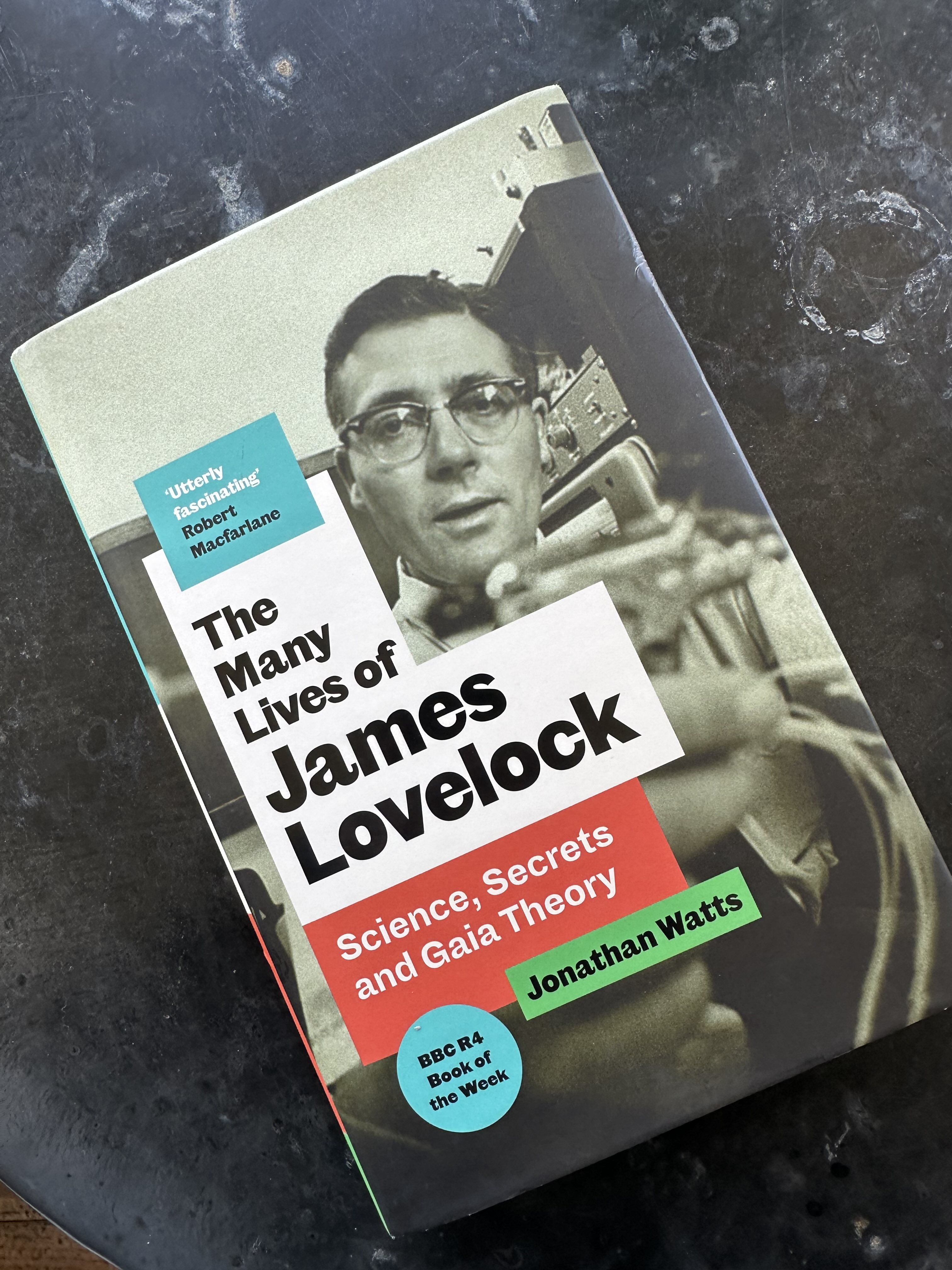
If you have been variously inspired, confused and infuriated over the years about James Lovelock, then this wonderful biography is a revelation. It’s a book that is impossible to put down. It explores the deep roots of Lovelock’s brilliant but often idiosyncratic character.
It doesn’t try to offer trite answers to this complex character, but does reveal surprising insights you won’t find anywhere else. It is so revealing that Lovelock’s undoubted brilliance in matters of science, was not matched by an equally advanced emotional intelligence.
Instead, we see an emotional vulnerability that was exploited by dark forces to co-opt him to an industry narrative on several occasions. Ultimately, he acknowledged this. I wonder if it was in part due to his fiercely declared independence, and not to be seen as a leader of a green movement he saw as too susceptible to wooly thinking?
In my mind, his reaction to the green movement was rather in keeping with Le Chetalier’s Principle: a system will react to any constraint so as to oppose the constraint. He might have appreciated that chemistry metaphor! He seemed happier to express contrarian opinions, almost because it ruffled feathers. Unfortunately this then served the needs of those arch Machiavellian manipulators – notably Rothschild and Lawson – who played him, time and again. His need to please in such cases seemed to override his critical faculties in political matters, which he was so ill equipped to deal with.
The lasting feeling I had on finishing the book was one of poignancy. Lovelock achieved so much, and recognition aplenty, but he was never quite rewarded with the recognition of mainstream science he seemed to both recoil from but also craved.
At first I wondered how a biography whose chapters were titled by the key people in his life could work, but it worked brilliantly. The themes – a love of nature, invention, multidisciplinary problem solving, bombs and more – run through the book like a piece of Brighton rock, as does the evolution of the Gaia vision, from a formative idea to a fully fledged form that finally achieved scientific respectability; and continues to resist being pinned down.
I thoroughly recommend this biographical masterpiece.
 EssaysConcerning