Tag Archives: history

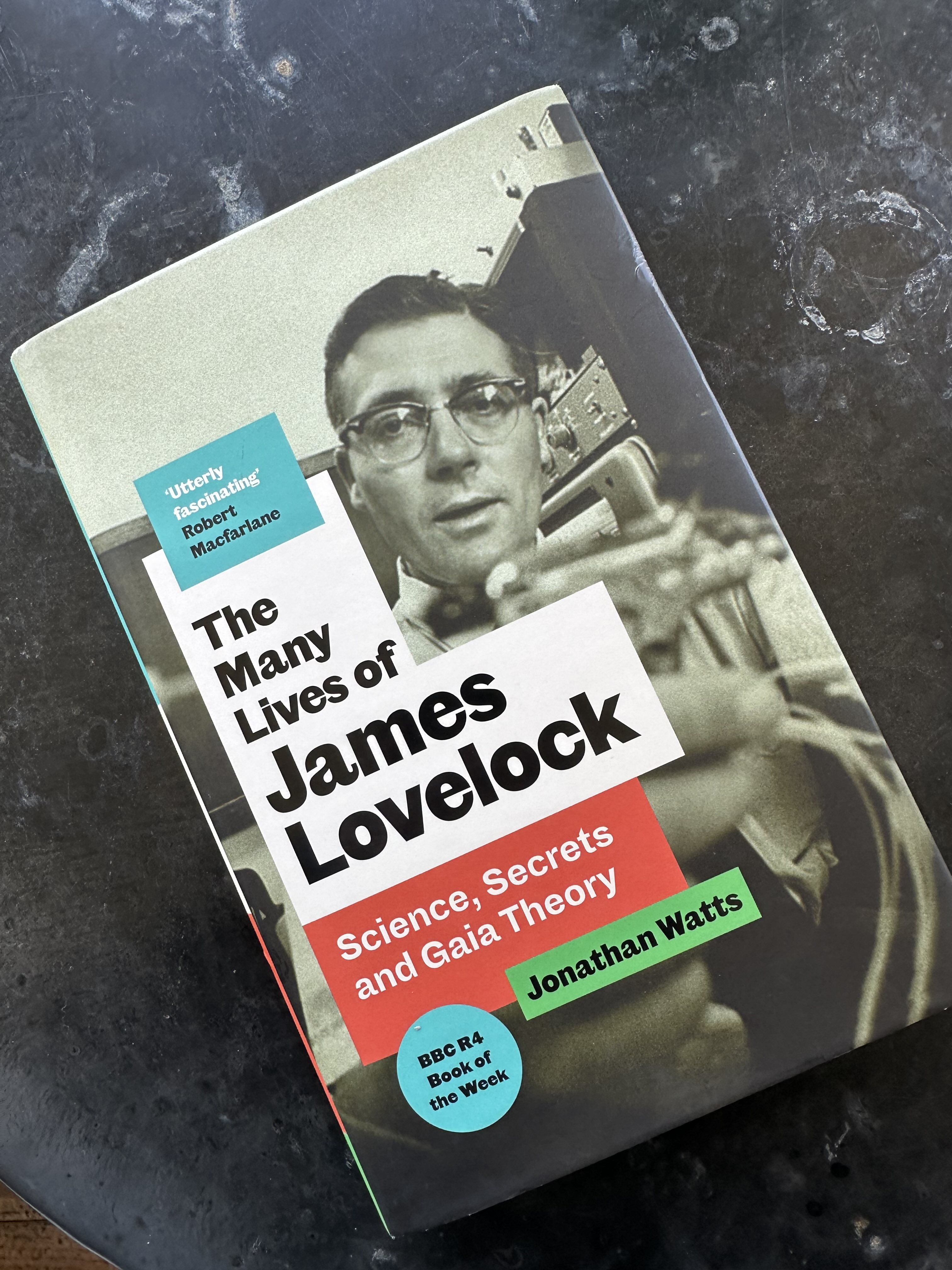
The Many Lives of James Lovelock: Science Secrets and Gaia Theory

My short review of ‘The Many Lives of James Lovelock: Science Secrets and Gaia Theory’, Jonathan Watts

If you have been variously inspired, confused and infuriated over the years about James Lovelock, then this wonderful biography is a revelation. It’s a book that is impossible to put down. It explores the deep roots of Lovelock’s brilliant but often idiosyncratic character. 

It doesn’t try to offer trite answers to this complex character, but does reveal surprising insights you won’t find anywhere else. It is so revealing that Lovelock’s undoubted brilliance in matters of science, was not matched by an equally advanced emotional intelligence.

Instead, we see an emotional vulnerability that was exploited by dark forces to co-opt him to an industry narrative on several occasions. Ultimately, he acknowledged this. I wonder if it was in part due to his fiercely declared independence, and not to be seen as a leader of a green movement he saw as too susceptible to wooly thinking?

In my mind, his reaction to the green movement was rather in keeping with Le Chetalier’s Principle: a system will react to any constraint so as to oppose the constraint. He might have appreciated that chemistry metaphor! He seemed happier to express contrarian opinions, almost because it ruffled feathers. Unfortunately this then served the needs of those arch Machiavellian manipulators – notably Rothschild and Lawson – who played him, time and again. His need to please in such cases seemed to override his critical faculties in political matters, which he was so ill equipped to deal with.

The lasting feeling I had on finishing the book was one of poignancy. Lovelock achieved so much, and recognition aplenty, but he was never quite rewarded with the recognition of mainstream science he seemed to both recoil from but also craved.

At first I wondered how a biography whose chapters were titled by the key people in his life could work, but it worked brilliantly. The themes – a love of nature, invention, multidisciplinary problem solving, bombs and more – run through the book like a piece of Brighton rock, as does the evolution of the Gaia vision, from a formative idea to a fully fledged form that finally achieved scientific respectability; and continues to resist being pinned down.

I thoroughly recommend this biographical masterpiece.

Leave a comment

Filed under Uncategorized

Is hope possible in the dark shadow of the Holocaust?

I’ve been listening to coverage of Holocaust Day on BBC Radio and elsewhere. A lot of the coverage rightly centres around the stories of brave survivors who somehow lived to tell their stories of life and death at Auschwitz-Birkenau. 

I heard no mention of the camps whose only function was murder soon after arrival of the trains,  the Extermination or Death Camps built for the Nazi’s Aktion Reinhard plan: Belzec, Sobibor and Treblinka. 

Why is this? I want to try to address this question.

In Concentration Camps like Buchenwald and numerous others, dehumanisation and ‘death by work’ was the goal. The Nazis wanted a financial outcome to run alongside their goal of genocide. This required inhumane care and lodging, but as a result there were buildings and other physical records of life and death at the camp.

For those of us trying to make sense of this still recent horror, it also meant that the few that did survive could offer some kind of hope. An emotional release from the darkness. In the words of Primo Levi “To survive is to defy those who would wish to see you erased from existence.”

The greatest focus is naturally on Auschwitz-Birkenau, which was numerically the most deadly of the camps, but it is also unique in having been both a Concentration Camp and an Extermination Camp.  This creates an ambiguity about how to talk about this particular camp. It can be difficult to navigate (and explains why some commentators refer to it as a Concentration Camp and fail to mention the Extermination part). It can also enable Holocaust deniers to create their own wicked narratives.

As Channel 4 News tonight said, the story of the holocaust was not a story of those that lived, because the norm was that most died: the mass shootings all over Europe that preceded the camps (often eagerly supported by local antisemitic neighbours), and the build-up to the industrialisation of genocide. In all, the Holocaust created six million stories of lives brutally taken.

Laurence Rees remarked on the lack of attention to the purely Extermination Camps in his seminal  book on the Holocaust (Auschwitz: The Nazis & The ‘Final Solution’, BBC Books, 2005):

“Visitors to the sites of Belzec, Sobibor and Treblinka (of who there are far, far fewer than travel to Auschwitz) are shocked by how tiny these killing camps were. A total of around 1.7 million people were murdered in these three camps – 600,000 more than the murder toll of Auschwitz – and yet all three could fit into the area of Auschwitz-Birkenau with room to spare. In a murder process that is an affront to human dignity at almost every level, one of the greatest affronts – and this may seem illiogical unless you have actually been there – is that so many people were killed in such a small area.”

I simply think that news outlets, and most of us actually, find it simply unbearable, and beyond our comprehension to even think about the monstrosity of the industrial murder of so many. Belzec, Sobibor and Treblinka seem to leave a blank space in our historical remembrances, because there are apparently no stories to tell of survival amongst the horror, only a blank sheet. Yet even that is not quite true. 

One of the most remarkable stories of survival was the ‘Treblinka Revolt’ by Samuel Willenberg and many others, on the 2nd August 1943. These were victims who actively rebelled, with great purpose and planning, against their enforced passivity.

Why is this story not told each year? 

Even while their numbers were small when tallied against the huge numbers that were murdered, we see in this story a willingness to stand up and be counted. A lesson to all of us who have infinitely more agency to confront hate and division.  

Ultimately, the Nazi’s were confronted and defeated in their war against humanity, and there lies hope too. The good guys won.

Those who seek to divide in the name of an ideology, to achieve absolute autocratic power, will always dream of some distorted vision of a homeland: one that is ‘cleansed’ and made uniform in many ways, even in terms of artistic expression. These people hate diversity.

Yet we know that nature is most successful at its most diverse. Monocultures wither and die. Human society is no different. David McWilliams’s recent brilliant book ‘Money – A Story of Humanity’ gives numerous examples of how cultural plurality provides the spur for wealth and happiness. The cultural monoculture that Hitler dreamed of led to destruction not hope and happiness.

Is hope possible in the shadow of the Holocaust?

Assuredly it is, because humanity has shown that open societies with cultural diversity are the most successful, providing the basis for wealth and happiness. We must continually work to make this a reality, in our own time, faced with the latest incarnations of monoculturalists and autocrats. History teaches us that open, multicultural societies will always prevail in the end, and are worth defending.

Hope depends on it; depends on us.

(c) Richard W. Erskine, 2025

1 Comment

Filed under Uncategorized

Can King Donald Hold Back the Green Tide?

History taught in my young days often gave us a cartoon version of the past. A great example is that of King Canute who showed to his  flattering courtiers that he could not turn back the tide; that his secular powers were no match for the almighty. It was a teaching moment by a wise King.

But of course this was mutated into a comical converse version of history: it became a poor old King Canute tried to turn back the tide, ha ha version of history.

King Donald, as he no doubt sees himself, also surrounded by flattering courtiers, believes he can turn back the tide of the green transition, but he can’t and he must not.

Christina Figueres in the piece Finding Optimisim In Outrage, guest editing a post on Katharine Hayhoe’s Talking Climate blog, uses a boulder metaphor:

“Clean energy is like a giant boulder that’s already reached its tipping point and is now rolling downhill toward a greener future. It’s got millions of hands on it, from individuals to some of the biggest countries, cities, and companies in the world. It could still be slowed by actions of governments and corporations—delays that will have serious consequences for people and planet alike—but it can’t be stopped. Gravity, history, and progress are on our side.

The cost of renewables has fallen exponentially, and while there is a long way to go the boulder has passed a tipping point – we are on a rising trend on a typical S curve of transition:

“The S-curve is a well-established phenomenon where a successful new technology reaches a certain catalytic tipping point (typically 5-10% market share), and then rapidly reaches a high market share (i.e. 50%+) within just a couple more years once past this tipping point.”

So, like the tide the green transition cannot be turned back.

I wonder what future historians will make of King Donald?

Schoolchildren will no doubt laugh at his scientific illiteracy and attempts to hold back the tide, but in this case they will reflect an accurate interpretation of history.

Unlike the wise King Canute, the foolish King Donald truly believes he can hold back the green tide, but while he can throw spanners in the works – and S curves always have ups and downs along the way – he cannot hold back the tide.

Yet that is no reason now for all of us not to give that boulder a helping hand, to speed it on its way.

Back to work!

(c) Richard W. Erskine, 2024

Leave a comment

Filed under Uncategorized