
If you read newspapers like The Telegraph or listen to campaigners like Dale Vince, you will get a very certain “Yes” in answer to this question.
Yet it is not difficult to find experts who disagree. If you get a ‘Heat Geek’ trained heat pump engineer to install your heat pump, they’ll guarantee performance levels that mean you don’t need to pay more.
If you are now confused, you have every right to be. So how can diametrically opposed answers be arrived at from the same data?
Ah, there’s the rub, because it is not the same data. Dale Vince / Ecotricity use the worst case (old) performance figure for heat pumps and the best case performance figures for gas boilers [Ref. 4]. This report is rebutted in some detail in a Carbon Brief commentary [Ref. 5].
When combined with a very high unit price for electricity when compared to gas, it’s very easy to make heat pumps look bad.
When we use realistic, contemporary figures, the answer changes. We’ll come on to that below.
Firstly, it is important to realise that there are 4 parameters that determine whether a heat pump or gas boiler will be cheaper to run:
- the unit price of electricity;
- the unit price of gas;
- the efficiency of the ASHP system;
- and the efficiency of the gas boiler system,.
Note that when we talk about the ‘efficiency’ of a heating system it is important to realise that the overall efficiency of the system is made up of a number of elements:
- the inherent efficiency of the heating source;
- the effective operation of the heating source (e.g. using the lowest flow temperature you can use that still meets the heat demand; using ‘weather compensation’ to make sure it works only ever as hard as it needs to – no more, no less);
- the heat distribution (e.g. sizing and quality of pipework);
- and heat delivery (e.g. effective surface area of radiators, including fins, or other means).
When we talk about efficiency below we mean the overall efficiency of the system, which is what counts as that is what delivers heat to occupants of a dwelling. It is what they experience.
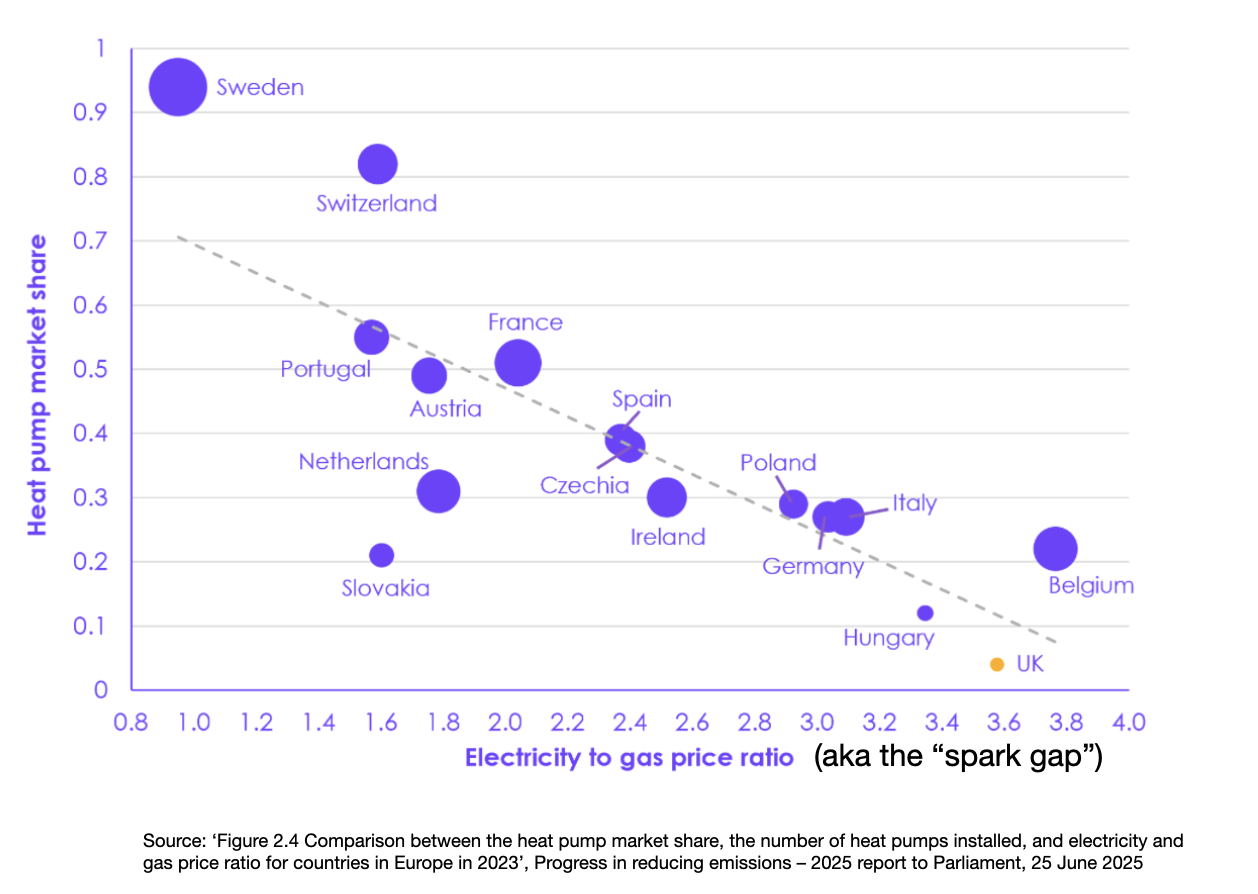
The ratio of the electricity unit price to the gas unit price is called the ‘spark gap’. In Sweden it is about 1 (i.e. no gap), whereas the UK is an outlier where the spark gap is currently over 4. It is especially bad in the UK when compared with other European countries, and is an outlier in Europe along with Belgium (see Note 1).
Even in the UK, if one is switching out an old gas boiler for an air-source heat pump (assessed and installed by a competent heat pump engineer), with an easily achievable good performance, even in an old leaky house, you will not pay more for your heating bills.
That’s the short version. Now for a deeper dive looking at what happens as the spark gap changes (as it has already begun to do so) towards a less extreme level than it is today, and considering different efficiency levels for the boiler and heat pump respectively.
A Deeper Dive
I’ve thought hard about how to visualise the issue. I steered well away from graphs as most people find graphs difficult.
The efficiency of a heat pump is often expressed as a Seasonal Coefficient Of Performance (SCOP), measured by the heat energy delivered over a year divided by the electrical energy input (see Note 3). A boiler also has a SCOP, which is the heat delivered divided by the calorific energy of the gas input over a year. A heat pump will always have a much higher SCOP than a boiler because it harvests energy from the environment.
An old gas boiler like the 25 years old one I had until 4 years ago has a ‘list’ SCOP of 0.72 (72%), whereas a modern condensing gas boiler should be able to achieve 0.9 (90%).
Heating engineers more often than not fail to properly install gas boilers (they set the flow temperature to a high temperature, and then it fails to ‘condense’ and that undermines its performance) [Ref. 2]
A study commissioned by the Energy Saving Trust found that in reality the average SCOP achieved with modern gas boilers was 0.83 (83%) [Ref. 1], well below 0.9.
Whereas for Air Source Heat Pumps (ASHPs), a lot of people (and Ecotricity / Dale Vince is no exception), rely on a 2021/22 Catapult study that found an average SCOP of 2.8 (280%) [Ref. 3]. These Catapult findings were criticised at the time, but are now increasingly seen as old and unreliable in what has been a maturing industry.
Heat pump experts would regard such a figure today as bad practice. Heat Pump Monitor is a live data feed for ASHP installs that follow good practice and they find an average SCOP of 4, as a Carbon Brief rebuttal of the Ecotricity report explains [Ref. 5]. This rebuttal includes the following quotation:
“Dale Vince has drawn some very strong conclusions about heat pumps from quite flimsy data. Like Dale, we’d also like to see electricity prices come down relative to gas, but we estimate that, from April, even a moderately efficient heat pump on a standard tariff will be cheaper to run than a gas boiler. Paired with a time-of-use tariff, a heat pump could save £280 versus a boiler and adding solar panels and a battery could triple those savings.” Madeleine Gabriel, Mission Director, A Sustainable Future at Nesta
And this does not rely of lots of insulation. My Grade 2 Listed, 200 year old home, that has minimal ‘fabric’ measures (sash window brushes and regulation loft insulation), achieves a SCOP of over 3.5 (350%) [Ref. 6]
The question then is not in my view “is the house cheaper to run with a well installed ASHP versus a well installed new gas boiler?”, but for those considering the move from an existing gas boiler and not wanting their bills to rise “will my bills rise in moving from my old gas boiler to a new ASHP?”. I did a little maths so you don’t need to [see Note 2 if you are curious], and the graphics that follow are the result.
Let’s take the spark gap that existed in the first quarter of 2026. It was an eye-watering 4.7. Now, depending on both the SCOP of the ASHP and the SCOP of the gas boiler, we’ll either pay the same or less (green coloured squares), or more (red colour squares), as we see in the matrix:
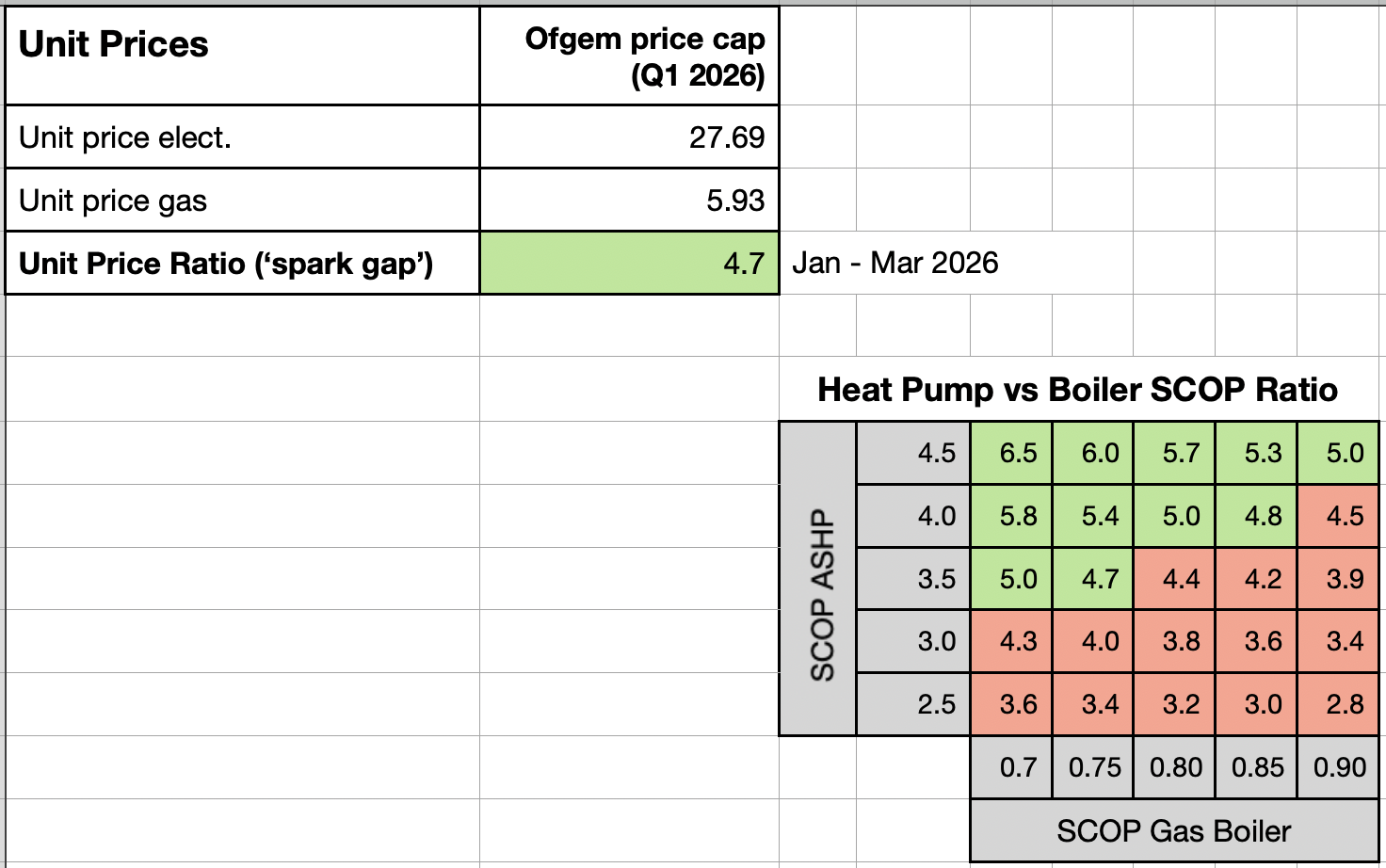
It shows that with this spark gap, moving from a 25 year old gas boiler with a SCOP of 0.75, would require the ASHP to have a SCOP of at least 3.5. If it was a new boiler being switched out, with a SCOP of 0.85, then the ASHP would then require a SCOP of 4, which is harder to reach but achievable.
With moving some of the costs that had been loaded on electricity to general taxation, the spark gap in April 2026 has reduced to 4.3. The picture changes:
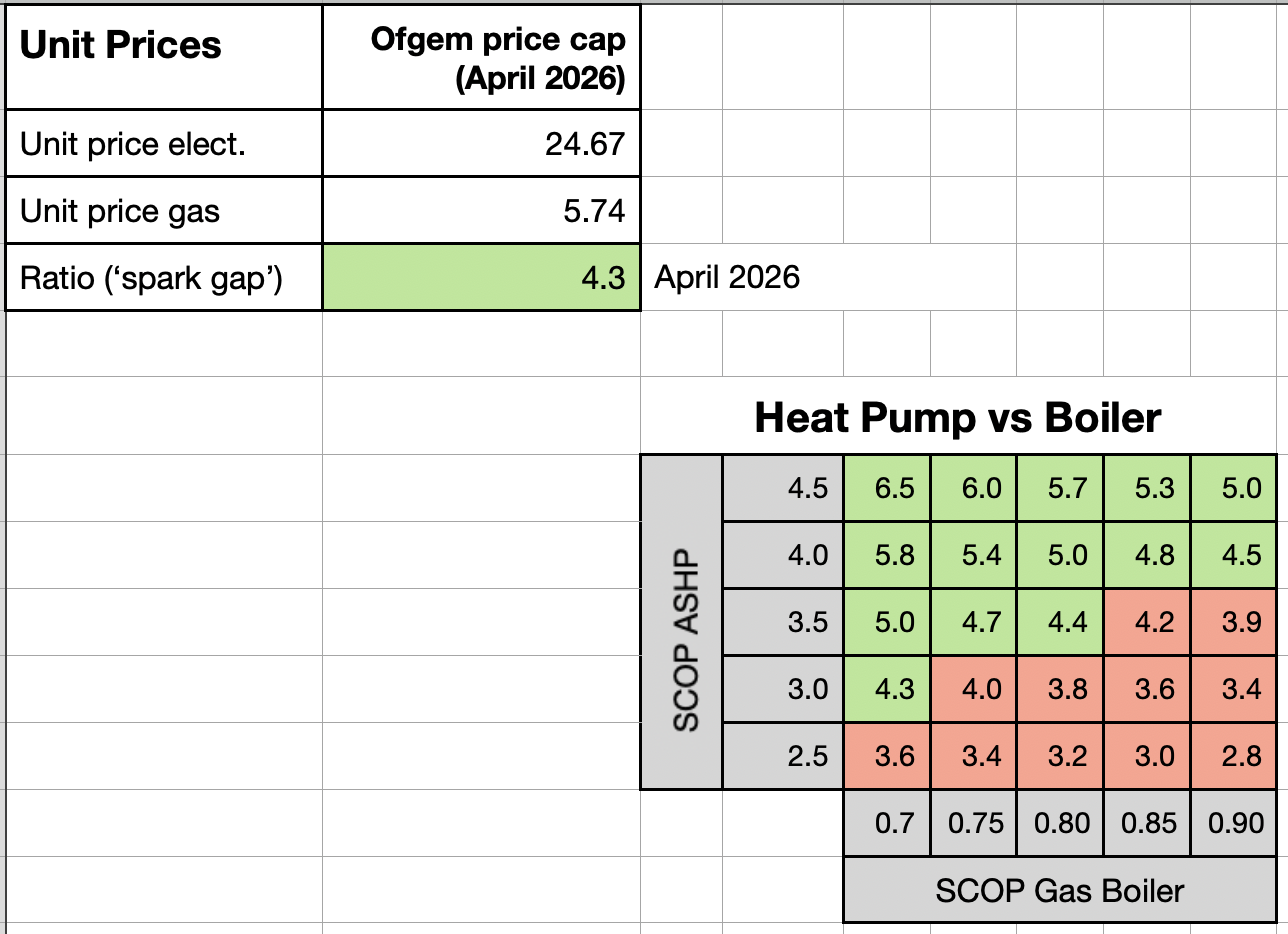
Now we see more green squares meaning more cases where the transition will be running-cost neutral or better. Here, even assuming a boiler efficiency of 90% (SCOP of 0.9), we can run the heating cheaper with an ASHP with a SCOP of 4, which is perfectly achievable with a skilled heat pump engineer.
With the UK Government announcement [Ref. 8] regarding changing the way electricity is priced, to decouple it from the price of gas, the spark gap will reduce. It will take time for these changes to shake out, and it is a tweak to the current market not a fundamental re-design. Nevertheless, even without these changes, the increasing renewables capacity will mean that gas has less opportunities to set the price of electricity [see Note 4].
Combining the policy changes and increased capacity mean we should see a trend in the spark gap over the next few years.
Let’s go with a spark gap that is 3.8 in 2027, 3.0 in 2028, and 2.5 by 2030 as some have suggested; a mid-European goal that seems realistic [see Note 1].
A figure of 2.5 will still be more than several European countries, but given the efficiency of heat pumps, we do not need the spark gap to drop to the level of Sweden to achieve the transformational change in heat pump take-up that we need.
Let’s see how the picture may change, given a downward trend in spark gap, over the next few years:
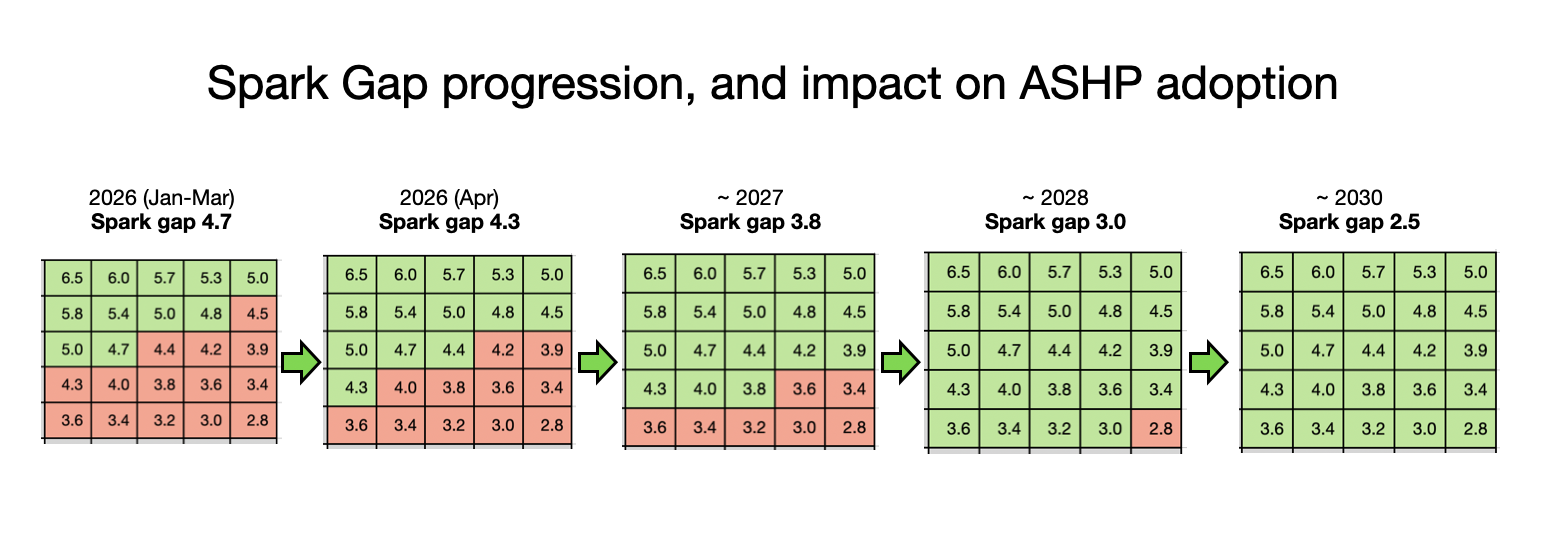
The short answer is that it is perfectly possible today – using realistic numbers – to not pay more when moving from an old gas boiler to a heat pump.
It’s more challenging but not impossible to do so for a modern gas boiler with an efficiency of 85%. But no one is suggesting ‘ripping out’ a brand new boiler. There is plenty of work to be done phasing out existing boilers as they approach a natural end of life. They can then all be changed over in the next 10-20 years.
We just need to stop replacing old boilers with new boilers, locking in another 20 or 25 years of carbon emissions from burning natural gas.
It becomes increasingly easier to make the numbers work as the spark gap reduces.
With this anticipated progression in the spark gap, by 2030, we’d expect even the worst heat pump install to be cheaper to run than the best gas boiler install!
No doubt many will still repeat the myths about heat pumps that have been debunked by Carbon Brief [Ref. 7].
Householders, local authorities and businesses will by then all have moved on, having recognisd that heat pumps really are as good as they are cracked up to be.
© Richard W. Erskine, 2026 (updated 3 June 2026)
References
[1] Final Report: In-situ monitoring of efficiencies of condensing boilers and use of secondary heating, energy saving trust, June 2019 https://assets.publishing.service.gov.uk/media/5a75149be5274a3cb28697f7/In-situ_monitoring_of_condensing_boilers_final_report.pdf
[2] Why our condensing boilers do not condense, Jo Alsop, 5th March 2020, The Heating Hub https://www.theheatinghub.co.uk/why-our-condensing-boilers-do-not-condense
[3] Electrification of Heat Demonstration Project, Catapult Energy Systems, 8th January 2025 https://es.catapult.org.uk/project/electrification-of-heat-demonstration-project/
[4] The Cold Hard Facts About Heat Pumps, A Green Britain Foundation Report, January 2026, https://www.ecotricity.co.uk/our-news/2026/new-report-exposes-the-cold-hard-truth-about-heat-pumps
[5] Factcheck: What it really costs to heat a home in the UK with a heat pump, Simon Evans, 30th January 2026, Carbon Brief https://www.carbonbrief.org/factcheck-what-it-really-costs-to-heat-a-home-in-the-uk-with-a-heat-pump/
[6] Heating a listed Cotswold stone building with an air-source heat pump: our journey, Richard Erskine, 29th March 2023, essays concerning.com https://essaysconcerning.com/2023/03/29/heating-a-listed-cotswold-stone-building-with-an-air-source-heat-pump-our-journey/
[7] Factcheck: 18 misleading myths about heat pumps, Jan Rosenow, 21 March 2023 (Updated 28 August 2025), Carbon Brief https://interactive.carbonbrief.org/factcheck/heatpumps/index.html
[8] The era of clean energy security, Ed Milliband, https://www.gov.uk/government/speeches/the-era-of-clean-energy-security
NOTES
Note 1 – European ‘Spark Gap’
As the Climate Change Committee reported to Parliament in June 2025, there is a wide range of values for the spark gap across Europe from no gap at all in Sweden to outliers UK and Belgium with the highest spark gap (that rose again after this). Mid-range countries like Spain have a spark gap closer to 2.5, which is a reasonable target for the UK
Note 2 – Some Maths
There is not need to read this addendum unless you are interested in the underlying method used in develping the matrices.
Suppose the heat energy needed to heat a building over a year is denoted by H.
The for a heat pump with a SCOP (Seasonal Coefficient Of Performance) of SCOPe to deliver enough energy it will use Ee units of electricity such that
H = SCOPe x Ee
The same holds true for a gas boiler with a SCOP of SCOPg, and gas energy input of Eg
H = SCOPg x Eg
The cost of heating with the heat pump will depend of the unit cost of electricity Ue and the electricity used, Ee.
Cost(e) = Ue x Ee
The cost of heating with the boiler will depend of the unit cost of gas Ug and the gas used, Eg.
Cost(g) – Ug x Eg
We want to have a running cost for the heat pump that is less than or equal to the gas boiler, so
Cost(e) <= Cost(g)
Using the previous equalities that means
(Ue x H) / SCOPe <= (Ug x H) / SCOPg
This relationship doesn’t depend on H (it can be cancelled out) because we are looking at the relative cost of a heat pump and cost boiler for a given house, so we want
Ue / SCOPe <= Ug / SCOPg
Rearranging we find we need
Ue / Ug <= SCOPe / SCOPg
The left hand side is the ‘spark gap’ so we need
‘Spark gap’ <= SCOPe / SCOPg
or equivalently,
SCOPe / SCOPg > ‘Spark gap’
And that is why I used the table with SCOPe on one axis and SCOPg on the other and the ratio SCOPe/SCOPg as the intersecting squares, coloured green if indeed the ratio is greater than ‘Spark gap’, which in plain english means …
‘when the relatively higher efficiency of the heat pump (compared to a gas boiler) overrides the relatively high unit price of electricity (compared to gas)’
Note 3
Technically, SCOP traditionally was used in a narrow sense of the calculated efficiency of the heat pump, and SPF (Seasonal Performance Factor) was used to represent the measured overall efficiency of the system. However, the usage of the SCOP term is now ubiquitous and almost without exception used to represent the actual (measured) efficency of the system overall. So, before I get called out by any pedants out there, and remembering this is a piece for the lay person, I’m following the current popular usage of SCOP.
Note 4
We have a ‘marginal pricing’ or ‘meit order’ way of princing electricity. Every half hour, the price of electricity is set by the most expensive unit to come on line. There was good logic to that. It meant that expensive to run but crucial back-up energy was there as a backstop as needed. This is explained here: Energy UK Explains: Why marginal pricing is the cheapest way to run our electricity market, EnergyUK, 27th March 2026 https://www.energy-uk.org.uk/publications/energy-uk-explains-why-marginal-pricing-is-the-cheapest-way-to-run-our-electricity-market/
However, this can mean that if low cost wind provides all the electricity we need for 29 minutes in a 30 minute window, and high cost gas comes in for the last minute, the price of electricity for the whole 30 minutes is charged at the higher price.
The issue now is that grid constraints mean we are often needing to curtail wind from Scotland or North Sea, needed in the south of UK, for example. As renewables further increase the percentage of power they deliver to the grid, and as electricity demand increases with the growth of EVs and heat pumps, there’s a clear need to reform the market.
The latest Government announcements are not a fundamental change, but are a positive step that should reduce the indefensiblly high spark gap that has existed for too long.


