Tag Archives: sustainability

Climate Shaming 3.0

If people are confused about what to do about climate change in their everyday lives, they have every right to be. 

Fossil fuel companies have for decades funded disinformation through a network of ‘think tanks’, and commentators, planting stories in the media. This was all helped by PR and Advertising agencies who know how to play with people’s emotions; to create fear, uncertainty and doubt.

Many have explored this issue more deeply than I ever can or will. Notably, Oreskes and Conway showed, in their book Merchants Of Doubt [1], how the same tactics used to promote smoking and deny its harms, were used by tobacco companies.

We might imagine we can now see through their tactics. I’m not so sure. I feel there is a tendency amongst some progressives to almost fall into the trap of amplifying the messages.

I am thinking of how some who claim that heat pumps are for the comfortably well off and it’s not fair to push them for those in energy poverty. The alternative – to stick with the comfort zone of insulating homes – came to be the default. This is not fair to anyone. 

Before we get on to that, let’s start with the birth of ‘climate shaming’.

Climate Shaming 1.0: It’s your demand that’s the problem!

It is well established that fossil fuel companies like Exxon and their network decided to make you, the consumer, the problem [2].

The message:

It’s you driving your car and running your gas boiler. We are just meeting your demand, so don’t blame us.

Intended result:

Guilt, denial and inaction.

It is even alleged that BP and their communication agency Ogilvy cooked up the idea of ‘carbon footprint’ [3].  We could all then measure our level of guilt. No wonder people often resorted to tiny actions to salve that guilt, when they felt powerless to do more.

Yet, there is a counter argument that while this was and remains a key plank in the strategy to delay action, measuring things can be useful. What is needed is to shake off the guilt and find ways to act.

Climate Shaming 2.0: It’s all your fault!

Shaming has metastasised into everything we do that we can feel guilty about, where fossil fuels are often out of sight.

There are many voices at work here, but in the background, fossil fuel interests are keen to keep the heat on you, dear citizen, rather than them. 

They will claim to be doing their bit, with greenwashing PR and advertising … now over to you people! 

While they don’t control every part of this conversation we have amongst themselves, they have the wherewithal to influence it in a myriad of ways. The message we receive is, “don’t do this bad thing” (but we, fossil fuel interests, won’t help you):

Don’t fly to Europe (but we won’t divert fossil fuel investments into trains)

Don’t eat meat (but we’re happy to reinforce your guilt, when the Amazon burns; for cattle feed)

Don’t eat Ultra Processed Foods (but like this behemoth, we work hard to ensure law makers give our fossil fuel interests a free pass)

Feeling guilty? Feeling helpless?

(laughing emoji from fossil fuel boardrooms)

Recognising our agency

We are told by some progressive politicians and commentators that it’s all about system change, and that we should reject the idea that it is our fault. We can’t take an EV Bus if there is a bad bus service (and they are still run on diesel), we need to invest in rural public transport not just in the cities.

There is a lot of truth in this, but it isn’t quite that simple.

We are not separate from the system, and it is hardly ‘systems thinking’ to imagine such a separation. The system includes Government, business, civic society and the natural environment, interacting in numerous ways.

Citizen-consumers have a lot of identities (community members, consumers, voters, parents, volunteers, etc). These identities each have their own form of agency, which we can choose to use. We need the spirit of positive change in the choices we make:

To choose who to vote for. 

To chose where we spend our money. 

To choose where to go on holiday and how to get there (and if/how often to fly).

To modify our diet (reducing meat if not eliminating it).

To decide to buy quality clothing that is repairable (looking and feeling better).

To decide where we bank and where we invest through our pensions. 

Even when an action one would like to take (like getting an EV) is not yet in reach, one can keep exploring options and set a goal for when it does come within reach. 

Setting goals too is an achievement.

The shaming tactic of the fossil fuel interests is aimed at breaking our sense of agency. We have to organise and support each other and reclaim our agency, as individuals and as communities. 

The Take The Jump initiative [4] espouses practical steps we can take, while recognising we also need system change.

Electrification of energy end-use is a key threat to fossil fuel interests

There are a range of solutions available now to make a serious dent in our carbon emissions. The most significant and relatively easy thing to achieve is to electrify our primary energy and energy consumption. These solutions are so brilliant they have become a threat to fossil fuel interests, notably:

  • Electric Vehicles (EVs) of all kinds will not only clean up our towns and cities but are so much more efficient than their fossil fuel alternatives. They require only a third of the energy of a petrol/ diesel car to run them.
  • Heat Pumps are so much more efficient than their fossil fuel alternatives. They require between a third and a fifth of the energy needed to run a gas boiler.
  • Both EVs and Heat Pumps are powered by electricity.  When generated by solar and wind, it is both free and unlimited, because it is derived from the Sun (which deposits 10,000 times as much energy on Earth as humanity is ever likely to need).

There has been an incessant effort by the network of fossil fuel interests to plant stories and create memes aimed at trying to undermine this transition to clean, electrified energy use. 

They know they will eventually lose, because the science of thermodynamics and economic reality mean it’s inevitable. Yet they will try to delay the transition for as long as possible. They can then extract as much fossil fuels as they can, and avoid ‘stranded assets’. Whereas, if they truly cared about climate change they would be working to leave it in the ground.

This essay is not the place to enumerate every myth and piece of disinformation that relentlessly circulates on social media about EVs and Heat Pumps. Carbon Brief have done the myth busting for you [5].

Climate Shaming 3.0: It’s ok for you woke well-to-do!

In order to counter this threat a new form of shaming emerged, particularly in relation to personal choice. I’m calling it Climate Shaming 3.0.

If one believed the framing so often evident in right-wing papers like the Mail and Telegraph titles, EVs and Heat Pumps are (paraphrasing)

… for the woke well-to-do – something they can afford but is not any good for most people …

If it was only these usual suspects one might try to shrug off this chatter.

Unfortunately, there has emerged an unholy alliance amongst those who would regard themselves as green progressives (in a non political sense), who are in a way doing exactly what the fossil fuel messaging is intended to promote.

We have politicians of all kinds who have been cowed by toxic reporting on heat pumps who  – wanting to show they are addressing fuel poverty – will talk endlessly about the need to insulate homes. Yet they dare not use the words ‘heat pump’ for fear of being accused of elitism (even though a heat pump is a far more cost-effective route to decarbonising heating than deep retrofit [6]).

They must be laughing their heads off in the boardrooms of fossil fuel companies.

Is it really ‘climate justice’ to promote the poorly designed ECO (Energy Company Obligation) scheme that the NAO (National Audit Office) declared [7] has been a total failure? NAO found that external wall insulation, for example, has led to bad and often exceptionally bad outcomes 98% of the time. This has required very expensive re-work in many cases, compounding the injustice.

This is to be contrasted with the BUS (Boiler Upgrade Scheme) that – despite all the claims about a lack of skills in the sector – has helped to really pump prime the heat pump sector and can be regarded as a success. 

Communities like Heat Geek are really shaking things up too, to lower installation costs and improve the quality of installations (to the level already practiced by many small businesses with great track records).

The unholy alliance extends to plumbers, retrofit organisations, council officers, architects and politicians who claim you cannot heat an old building without deep retrofit. A disproven and false claim, but repeated as many times as the story about British pilots seeing better in WWII thanks to eating carrots. 

Some untruths live on through repetition.

The idea that we can insulate our way out of energy poverty, without also pushing at least as hard on rolling out heat pumps (individually or using shared heat networks) is an illusion, that would mean we’d be stuck with burning gas for much longer than necessary. 

More laughter from those boardrooms.

Insulation, replacing windows and other fabric measures are important but you can easily blow so much money on these that you leave nothing in the pot for a heat pump [6]. 

Here is a diagram from Nesta that was based on one I originally produced and here I have added some further annotations (see [6] for Nesta version):

That is not climate justice, or fair on anyone.

It is not climate justice for those in energy poverty to have to pay for gas that will inevitably go through repeated market crises and cost spikes in its dying decades. 

Climate justice is future proofing our electricity supply, the grid, our homes and our streets. 

These will then be not only cleaner and more efficient but future proofed. As the late Professor Mackay observed, once you have electrified end use of energy, the electricity can come from anywhere: from your roof, from a community energy project, or from a wind farm in the north sea.

It’s time that those that claim to be progressives stopped falling for the tactics of fossil fuel interests, that time and again are slowing our transition to a clean energy future, and action on climate change.

It started with shaming people for their consumption. Let’s not fall for the new tactic of shaming those who actually care enough to adopt effective solutions.

References

[1] Merchants of Doubt: How a Handful of Scientists Obscured the Truth on Issues from Tobacco Smoke to Global Warming, Naomi Oreskes and Erik M. Conway, 2010, Bloomberg Press.

[2] Exxon Mobil’s Messaging Shifted Blame for Warming to Consumers, Maxine Joselow & E&E News, Scientific American, 15th May 2021. 

https://www.scientificamerican.com/article/exxon-mobils-messaging-shifted-blame-for-warming-to-consumers

[3] Can fossil fuel companies really support a carbon tax?, Alain Naef, SUERF Policy Brief, No 724, November 2023. 

[4] Take The Jump, https://takethejump.org/

[5] Carbon Brief

[6] ‘Insulation impact: how much do UK houses really need?, NESTA, 8th January 2024, https://www.nesta.org.uk/report/insulation-impact-how-much-do-uk-houses-really-need 

[7] Energy efficiency installations under the Energy Company Obligation, 14th October 2025, National Audit Office https://www.nao.org.uk/reports/energy-efficiency-installations-under-the-energy-company-obligation/

Leave a comment

Filed under Uncategorized

Mind the ‘Spark’ gap

All the talk of the ‘spark gap’ – the particularly high ratio of electricity unit prices to gas unit prices – might deter people from getting a heat pump, because they think it will mean they will pay more for their heating than they do currently, but this is false in the majority of situations where householders are end-of-lifeing their old gas boiler.

Let’s run the numbers.

  • Take a building that currently that consumes 30,000 kWh of gas for heating per year.
  • At a gas unit price of 6p/kWh that totals £1,800 per year (for the moment, ignoring standing charges for simplicity)
  • Let’s assume the old gas boiler is 75% efficient (in many cases with will be quite optimistic).
  • So, building actually needs 22,500 kWh of heat reaching radiators (0.75 x 30,000 = 22,500).

So the question is, can a heat pump be cheaper to run with its high relative performance that counteracts the ‘spark gap’? Let’s see …

  • Let’s assume a reasonable minimum achievable heat pump system SCOP of 3.5
  • So heat pump needs 6,429 kWh of electricity to produce 22,500 kWh of heat ((22,500 / 3.5) = 6,429)
  • At a electricity unit price of 22p/kWh that totals £1,414 per year 
  • That is a saving of £386 on running costs

Health Warning: The difference is very sensitive to the ‘spark gap’ (ratio of electricity to gas unit prices), and crucially the SCOP. 

Now, I am not saying there is not an issue with the ‘spark gap’. Adoption rates in Europe show that the smaller the spark gap, the high the adoption of heat pumps (see ‘Figure 2.4 Comparison between the heat pump market share, the number of heat pumps installed, and electricity and gas price ratio for countries in Europe in 2023’, Progress in reducing emissions – 2025 report to Parliament, 25 June 2025).

However, when people talk about the spark gap they seem to assume the context is ‘buy a new gas boiler or buy a heat pump’. Needless to say that is a higher bar but not an insurmountable one. Many people who are concerned about climate change and have an ageing gas boiler simply want to know that their heat bills will not rise.

Now back to standing charges. I rerun the numbers for different SCOPs and included standing charges (see NOTES for assumptions). The ‘breakeven’ SCOP is then close to 2.9, which frankly only an incompetent heat pump installer would fail to exceed.

And what is more, for any of these SCOPs the carbon saving is at least 4 tonnes of carbon dioxide equivalent per year. So both the planet and the bank balance can be happy with the choice.

So, let’s fix the spark gap, but stop banging on about it as though it is a reason not to press on with rolling out heat pumps.

(c) Richard W. Erskine, 2025

NOTES

Assumptions used in table: With heat demand of 22,500 kWh and old gas boiler with efficiency of 0.75 (75%), so gas bill showing 30,000 kWh primary energy used by gas boiler. Used standing charges of 28p and 59p per day for gas and electricity, and unit rates of 6p/kWh and 22p/kWh, respectively. The breakeven running costs SCOP in this case is 2.935. Also, a carbon intensity of gas of 184 gCO2/kWh and for UK electricity grid (for 2024) of 124 gCO2/kWh; so even at a SCOP of 2.5 you save 4.37 tonnes of CO2 a year.

Leave a comment

Filed under Uncategorized

Loading the Climate Dice: Why ‘chaos’ does not prevent climate change predictability

Most people have heard about chaos theory, especially as it applies to weather, but may be a little fuzzy about what it all means. They may even hear people claim “if they can’t even predict the weather in a month’s time, how on earth can they tell us what the climate will be in 25 years time?!”.

It’s a fair challenge, but one that has been answered many times by climate scientists [1], but often in ways that perhaps are not as accessible as I feel they could be. When I was recently asked this question I was frustrated I could not share a plain English article with them.

So here is my attempt in plain, non-scientific language to explain how we can project future climate, despite ‘chaos’. I will use the analogy of rolling dice to help explain things – so no equations or mathematical jargon, I promise.

Chaotic Weather

Let’s start with the discovery of ‘chaos’ by Lorenz in 1963 [2]. Weather projections have to start from the current state of the weather and then project forward. The models incrementally step forward to see how the weather patterns evolve over minutes, hours and days. Lorenz discovered that even with the simplest models, if one did two ‘runs’ of the model which had an infinitesimal difference in initial conditions (eg. the temperature in Swindon at 15.0oC and 15.00001oC) the predicted weather can look very different in just a few weeks..

If this was just a trivial observation that errors can magnify themselves in a complex system, one might be tempted to shrug one’s shoulder – and it was not even a new insight [3]. But Lorenz discovered something far more profound: beautiful patterns amongst the chaotic behaviour of complex systems (think of the eddy currents that appear in the turbulent flow of a river). For those interested in learning more about Lorenz’s mathematical legacy, Professor Tim Palmer gave an interesting talk on this [4].

I say ‘errors can magnify’ because sometimes you end up with a chaotic outcome and sometimes you don’t [5]. This is important if you are about to head off to Cornwall for your summer holiday. Weather forecasters now do multiple runs of the models varying the initial parameters [6]. If all the outcomes look similar then the weather system is not behaving chaotically – at least over Cornwall for the period of interest – and the weatherman can say confidently “it will be dry next week over Cornwall”. If, however, out of 100 runs, 20 indicate wet and windy weather, and the rest were dry, they’d say “There is a good chance of dry weather over Cornwall next week, but there is a 20% chance of wet and windy weather”, so take your waterproofs!

Predictable Climate

It really is all about the question being asked, as with most issues in the world. If you ask the wrong question, don’t be surprised if you get a misleading answer.

If I ask the question “will it be sunny in Cornwall on the 3rd of July of 2050?” (wrong question) then it is impossible to say, because of ‘chaos’. If, on the other hand, I ask the question “do we expect the average temperature over Cornwall to be higher in the summer of 2050 as a result of our carbon emissions compared to what it would have been without those emissions?” (longer but valid question) I can answer that question with confidence; it is “Yes”. 

This illustrates that when we talk about weather we are interested, as in our holiday plans or a farmer harvesting their crops, in the specific conditions at a specific place and specific time

Climate is very different, because it is about the averaged conditions over a longer period and typically wider area.

Throwing the dice

I want to illustrate the difference between these two types of question (specific versus averaged) by use of a dice [7] analogy.

If I throw a dice I expect that the chance of getting a 6 to be 1 in 6. If I ask the (specific) question ‘what will the hundredth throw of the dice show?’ (think weather), I am no more certain of the outcome than after 10 throws [8]. 

Now ask a different question: ‘what will be the average number of 6s after 600 throw?’ (think climate). I would expect it to be around about 100. As the number of throws increases I’d expect the average (number of 6s divided by the number of throws)  to get closer and closer to 1 in 6.

This is just how statistics comes to the rescue in the face of the much used, and abused, “chaos” in the climate debate.

You can do this yourself. Make multiple throws of a dice, and after each throw, take the count of the number of 6s thrown and divide by the number of throws – that is the observed odds. You might be surprised to find how long it takes before the odds settles down to close to  1 in 6.

Being lazy, I wrote a little program to plot the result (using a random number generator to do the ‘throwing’ for me). 

The averaged number of 6s converges on the expected odds of 1/6 (shorthand for ‘1 in 6’).

I then imagined two dice, one that was ‘fair’ (where the odds of throwing a 6 were 1 in 6) and a ‘loaded’ dice (where the odds have changed to 1 in 5). This is a analogy for a changed climate where carbon emissions have been happening for some time but have now stopped, and there is a raised but stable concentration of greenhouse gases in the atmosphere. This gives rise to a higher averaged temperature, represented by the higher odds of throwing a 6 in this analogy (see next illustration).

Despite the uncertainty in any specific throw (think weather) in both cases, the average chance of getting a 6 can be predicted (think climate) in both cases. We can see the loaded dice clearly in the graph, compared to the fair dice. In both cases it takes a little time for the influence of randomness (chaos if you like) to fade away as the number of throws increases.

However, the emissions have not stopped, and in fact have been growing since the start of the industrial revolution. There has been a significant acceleration in emissions in the last 75 years. So the amount of accumulated greenhouse gases in the atmosphere has been growing, and with it, the averaged surface temperature on Earth. 

So, taking the analogy one step further,  I created a dice that gets progressively more ‘loaded’ over time (think each year of emissions). 

Now, the averaged chance of throwing a 6 will progressively increase, compared to the fair dice. This is illustrated in the next graphic.

 Again, we see the averaged odds after a number of throws jump around for quite a while (think chaos), but things settle down after a several hundred throws. 

We now see a clear and ever widening gap between the two dice. 

This is analogous to what is happening with our climate: our continuing carbon emissions are progressively loading the ‘climate dice’.

No amount of weather chaos can cancel the climate statistics that become more evident with every year that passes.

Extreme Weather Events

Now while weather and climate are different, because climate is an average of what the weather is over time, there is an interesting flip-side to this. Since the climate changes due to our carbon emissions, that means the spread of possible weather must have also shifted, to generate a new average.

This means that extreme weather events become much more likely. 

Once again, this is just basic statistics. So events that may have been “one in a hundred years” become much more frequent, and very extreme events, like the 40oC we saw in England in 2022, that were “basically impossible” without our carbon emissions [9], now start to happen.

I don’t want to make this essay longer explaining how this works, and the Royal Statistical Society have done a great job on this, so please visit their explainer [10].

Extreme weather events are now popping up all over the world, almost on a weekly basis, and thanks to the statistics and associated modelling, scientists can now put a number on how much more likely each event has become due to our carbon emissions [11].

We have already loaded the climate dice, the question now is, how much more do we want to load it, and make the odds even worse?

© Richard W. Erskine, September 2025

Notes

  1. Chaos and Climate, James Annan and William Connolley, RealClimate, 4th Nov 2005.https://www.realclimate.org/index.php/archives/2005/11/chaos-and-climate/
  2. Edward Lorenz, Deterministic Nonperiodic Flow, Journal of the Atmospheric Sciences. 20 (2): 130–141, https://journals.ametsoc.org/view/journals/atsc/20/2/1520-0469_1963_020_0130_dnf_2_0_co_2.xml
  3. Stephen Wolfram wrote some historical notes on chaos theory https://www.wolframscience.com/reference/notes/971c/ 
  4. The Butterfly Effect – What Does It Really Signify, Tim Palmer, Oxford Mathematics, 19th May 2017, https://youtu.be/vkQEqXAz44I?si=bLBWR7hLNsHBaE5E
  5. Over the specific place and time period of interest, of course.
  6. This is called ‘ensemble modelling’. 
  7. For the grammar police: common usage now prefers ‘dice’ for singular and plural cases.
  8. In this sense, the dice analogy is somewhat different to climate, because climate change is conditional on what came before, but this does not change the point of the analogy – to distinguish between specific and averaged questions.
  9. UK’s 40oC heatwave ‘basically impossible’ without climate change, Georgina Rannard, 29th July 2022, BBC, https://www.bbc.co.uk/news/science-environment-62335975 
  10. Explainer: Extreme Weather, Royal Statistical Society, https://rss.org.uk/policy-campaigns/policy/climate-change-resources/explainer-extreme-weather 
  11. World Weather Attribution, https://www.worldweatherattribution.org/ 

Leave a comment

Filed under Uncategorized

Is climate inaction the new denial?

I respect those wishing to protect nature who are worried about unrestrained infrastructure projects, but the ‘unrestrained’ bit was never part of the plan, and strawman arguments now abound, such as the claim we will be building solar farms on prime arable farmland. 

An astonishing 30% of UK land is devoted to grazing, and raised solar arrays can co-exist with grazing, even providing shade during heatwaves. It may even pay back some of the carbon impact of those methane burping ruminants. Solar grazing (or agrivoltaics) is now a thing in some countries so why is it not supported by organisations like the CPRE in the UK?

I have concerns about the impact of progressive weakening of the Government’s new infrastructure policies that may continue the blocking or delaying of essential on-shore renewable energy projects. 

In his seminal book over 15 years ago, Professor David Mackay wrote1:

If the British are good at one thing, it’s saying “no.”

No to this solar farm; no to that wind turbine on that hill; no to that wind farm off my coastline; etc.

This, despite the fact that the Government’s most recent public opinion survey2 shows 80% are   in favour of renewables; although when it comes to on-shore wind and solar farms in one’s locality, this drops to 37% and 47%, respectively. 

Is this because the public are not aware of the benefits of local energy production? Or because not enough of it is community owned? Is it that people do not understand the nature of the emergency we face and the imperative to act?

We’ve seen over the sequence of three heatwaves3 recently (heatwaves that have been made much more likely due to man-made global warming4) that our beloved commons around Stroud now look more like the Serengeti than our green and pleasant land. This will be the new norm by 2050 if we don’t urgently address our emissions. 

At this stage in the climate emergency, climate inaction is tantamount to climate denial.

The Climate Change Committee has made it abundantly clear that we need to electrify most of our economy to get to net zero expeditiously and affordably5: This applies to both generation and consumption:

“In many key areas, the best way forward is now clear. Electrification and low-carbon electricity supply make up the largest share of emissions reductions in our pathway, 60% by 2040. Once the market has locked into a decarbonisation solution, it needs to be delivered. The roll-out rates required for the uptake of electric vehicles (EVs), heat pumps, and renewables are similar to those previously achieved for mass-market roll-outs of mobile phones, refrigerators, and internet connections.”

and really at a much lower costs than many have claimed:

“We estimate that the net costs of Net Zero will be around 0.2% of UK GDP per year on average in our pathway, with investment upfront leading to net savings during the Seventh Carbon Budget period. Much of this investment is expected to come from the private sector.”

Much has changed since David Mackay wrote his book. The costs of renewables has dropped, so they are now the cheapest form of energy (and onshore cheaper still).. Yet I believe another kind of “No” has developed in the dialogue around renewables infrastructure.

There has emerged a false dichotomy between green energy infrastructure and nature. The case often presented is that to protect nature we have to limit infrastructure to only those places which no one cares about, like brownfield sites, which of course would completely undermine any attempt to reach the levels of onshore wind and solar that are needed to supplement off shore development. Whereas there are many things harming nature which are much worse including farming systems, tidy gardens, and climate change itself.

Take the rewiring of our electricity grid that is needed for an electrified economy. The case is made for burying cables as opposed to pylons because it is assumed they are environmentally less harmful, and despite the enormous increase in capital costs (and hence delays) that would result. In fact, burying the quite different ultra expensive cables needed in wide trenches can have impacts on flora and fauna, such as harm to tree roots and subsoil ecology, that can exceed those arising from pylons.

Isn’t the honest truth that people simply don’t like their view being changed by the addition of renewables to the landscape and some use the nature card to avoid being labelled NIMBYs? I fear so.

Rodborough Common 19th Juky 2025 by Richard Erskine

Conversely, we can fail to act and our grandchildren will see a landscape changed forever by our inaction. The MetOffice’s most recent State of The Climate report6 states that under the intermediate pathway scenario (RCP4.5) “years 2022, 2023, and 2024 would likely be considered average by the 2050s and cool by around 2100”. Is that preferable to some wind turbines today offering local energy security and resilience, helping the local community do its part in decarbonising our economy?

The good news is that because of the enormous efficiencies of electrification and the end of burning fossil fuels, the primary energy required from renewables – about 800 TWh per year – would be about one third of the primary energy hitherto required from fossil fuels. Even if we almost double this – to allow for new demands like synthetic meats, AI, minerals recycling, etc – to about 1500 TWh, an Oxford University study7 shows wind and solar can power the UK. As Hannah Ritchie summarises the findings8:

“They think there is a large potential for offshore wind. This would be spread over 10% of the UK’s exclusive economic zone. Onshore wind could be used on 5% of British lands, and combined with farmland. 2% of British land would be used for solar PV, and could also be combined with farmland using a technique called ‘agrivoltaics’. Rooftop solar doesn’t add much – the output is quite small, even if 8% of British rooftops are covered. Definitely still a good option for individuals, but maybe not for the nation as a whole.”

For those that say let others do it, because we are special, don’t be surprised if everyone claims the same. It is analogous to a parent who says let other children take the vaccine (while their child benefits from community immunity so they can avoid the very small risk of side effects of inoculation). If everyone made that choice, everyone is at risk. 

Have we, in short, become too selfish to take the steps to act with the urgency needed to actually take declarations of a climate emergency seriously; to go beyond laudable actions like recycling to really substantive endeavours?

We need to make the difficult decisions needed but work hard to take people with us, rather than stoke fears as some political parties choose to. The political debate has created some surprising bedfellows amongst those opposing onshore renewables projects.

Are we Brits just still too good at saying “no”?

© Richard W. Erskine, 2025

References

  1. David Mackay, Sustainable Energy without the hot air, 2008, https://www.withouthotair.com/c18/page_108.shtml
  2. DESNZ Public Attitudes Tracker: Headline findings, Spring 2025, UK, Published 3 July 2025, https://www.gov.uk/government/statistics/desnz-public-attitudes-tracker-spring-2025/desnz-public-attitudes-tracker-headline-findings-spring-2025-uk 
  3. Heat health alerts come into force as third UK summer heatwave builds, Ben Rich, 9th July 2025, https://www.bbc.co.uk/weather/articles/c9w1xpz841no 
  4. Explainer: Extreme Weather, Royal Statistical Society, https://rss.org.uk/policy-campaigns/policy/climate-change-resources/explainer-extreme-weather/ 
  5. The Seventh Carbon Budget, The Climate Change Committee, 26th February 2025, https://www.theccc.org.uk/publication/the-seventh-carbon-budget/ 
  6. State of the UK Climate in 2024, Mike Hendon et al, International Journal of Climatology, Vol. 45, No. S1, July 2025. https://rmets.onlinelibrary.wiley.com/doi/10.1002/joc.70010 
  7. Could Britain’s energy demand be met entirely by wind and solar?, Brian O’Callaghan et al, University of Oxford Smith School of Enterprise and the Environment, Working Paper No.23-02, September 2023, https://www.ox.ac.uk/news/2023-09-26-wind-and-solar-power-could-significantly-exceed-britain-s-energy-needs   
  8. Can solar and wind power Britain? An update of David MacKay’s numbers, Hannah Ritchie, Sustainabilitybynumbers, 30th October 2023. https://www.sustainabilitybynumbers.com/p/can-solar-and-wind-power-britain 

1 Comment

Filed under Uncategorized

The elephant (no, scientists) in the room

UK news coverage  just triggered me so please excuse me but really …

Good news: the coverage of heatwaves is drawing the link with climate change on BBC and C4.

Bad news: there seems to be a lot of surprise at this! The dry conditions and repeated heatwaves, causing head scratching on questions like ‘who knew?’, ‘does this herald worsening heat extremes?’, etc. 

Well hello people, this has all been completely obvious to scientists studying climate since at least the 1970s, but society has gone along with denial (yep, we’re all in denial, to some degree).

People talk about the elephant in the room – the thing no one has mentioned but really should not have been ignored. Well, here we have the scientists in the room, including the news room, and now regularly demonstrating the long prediced link between man-made global warming and extreme weather events and episodes..

The Metoffice produces frequent decadel forecasts that few read, and then people get surprised when we have another 100 year heat wave or 100 year flood (following the last one 5 years ago; remember 40C in UK in 2022).

Short memories, and shifting baseline syndrome.

When the odds keep changing the use of the phrase “100 year event” we heard from ‘the orange one’ in relation to the deadly Texas floods, is meaningless, and misleading, but unsurprising from someone who is well into his mission to dismantle the USA’s climate science capacity, weather forecasting, and ability to adapt and respond to extreme weather events (driven by man-made climate change that is the underlying driver).

Switch off if you want to, but the simple truth is that every tonne of carbon dioxide we emit cumulatively turns up the climate one-way ratchet and increases the risk of extreme weather events (at both ends of the hydrological cycle, because warmer air holds more water). 

More emissions. The dice gets loaded a bit more. The odds get changed a bit more. Repeat.

At this rate, by 2100, my great grandchildren will yearn for the (relatively) cool summers of the 2020s. 

And because CO₂ is a long lived greenhouse gas, don’t expect the atmospheric concentration of it to fall anytime soon. Ratchets turn in one direction. Give it hundreds to many thousands of years before long-term carbon cycles begin to reduce atmospheric concentrations to comfortable levels for humanity, but by then on a changed planet.

Prevention is better than cure with a vengeance in this case.

Worried about heatwaves? You should be but please, don’t be surprised.

Worried about the cost of net zero, then don’t be, as the Climate Change Committees 7th Carbon Budget explains:

“We estimate that the net costs of Net Zero will be around 0.2% of UK GDP per year on average in our pathway, with investment upfront leading to net savings during the Seventh Carbon Budget period. Much of this investment is expected to come from the private sector.”

And 0.2% of roughly £3 billion of GDP is just £6 billion a year (and most coming from industry), less than what the UK spends on fizzy drinks. Even the Government’s spending watchdog agrees. And what a fabulous investment with huge ROI (Return On Inhabitability).  The costs of inaction make the costs of action look small by comparison.

Reject the populist, science rejectionists,  who think denial wins votes.

I’ll always vote on behalf of those who come after us who I hope will be wiser, less selfish and less ignorant than our generation have been, yet will feel the full force of our failure to take urgent action when we should have.

Yet, it is not too late for us to reduce harms. The harm-free-option ship has sailed, but every tonne avoided makes a difference, and reduces the level and frequency of extremes to come. 

(c) Richard W. Erskine, 2025 

Leave a comment

Filed under Uncategorized

More and More and, surprisingly, Less

I was excited to get my hands on Jean-Baptiste Fressoz’s latest book More and More and More – An All-Consuming History of Energy [1]. He offers up a very lively critique of the notion of historic energy transitions – from wood, to coal, to oil and gas. 

His methodology aims to show how material flows are intimately linked to energy production in often surprising ways over time. For example we needed wood as pit props to mine coal, and in surprising quantities. Most of the book is devoted to examples of the symbiosis that has existed between the successive materials required to meet our energy needs. He mocks the idea of energy transitions with numerous well researched anecdotes, awash with surprising numbers. It is an entertaining read I would recommend to anyone.

However, I was expecting the book would close with some prescriptions that would show how the “amputation” the blurb called for could be achieved, but in the end he tells us he offers no solutions, or “green utopias”, as he discussed in an interview [2].

In the finale, he presents the newest energy transition – towards a world powered by renewables – as just the latest incarnation of a delusional concept, but largely abandons his methodology of using numbers to prove his case. I wonder why?

He does not deny the reality of a need to reduce carbon emissions, or the science of climate change, but it is clear he sees humanity’s insatiable appetite for energy as the central issue that must be addressed. He could have written a different book if that was his objective.

There are fundamental flaws in Fressoz’s scepticism of the renewables transition.

Solar abundance

The first of these is that the new source of energy that supplies our energy in a renewables future is our sun. Energy from the sun is a quite different category to that we extract from the ground.

The most pessimistic projection is that humanity, or what we may become, will have hundreds of millions of years left of usable energy from the sun [3]. No digging or extraction required. I’d call it functionally infinite on any meaningful timescale.

Not only that, but the sheer power of the sun’s energy is awesome, which we capture as wind, through photovoltaics, and the ambient energy harvested by heat pumps. As Frank Niele observed 20 years ago [4]:

“The planet’s global intercept of solar radiation amounts to roughly 170,000 TeraWatt [TW] ( 1 TW = 1000 GW). … [man’s] energy flow is about 14 TW, of which fossil fuels constitute approximately 80 percent. Future projects indicate a possible tripling of the total energy demand by 2050, would correspond to an anthropogenic energy flow of around 40 TW. Of course, based on Earth’s solar energy budget such a figure hardly catches the eye …”

It is clearly a category error to compare renewables with fossil fuels.

False equivalence

Ah, but what about the lithium and all those (scare story alert) “rare earths” needed to build the renewables infrastructure. This is the second flaw in the Fressoz thesis. The example of wood consumption for mining staying high even after the ‘transition’ to coal, is an example of an essential material relationship between the kilowatt-hours of energy produced and the kilograms of material consumed. This link does not exist with renewables to any meaningful degree. 

It has nevertheless become a popular belief amongst those questioning the feasibility of renewables. For example, Justin Webb on BBC Radio 4 [5] posed this question:

“Is it also the case of us of us thinking whether we can find some other way of powering ourselves  in the future … [we are] just going from taking one out of the ground – oil – into taking another thing or another set of things just isn’t the answer, isn’t the long-term answer for the planet.”

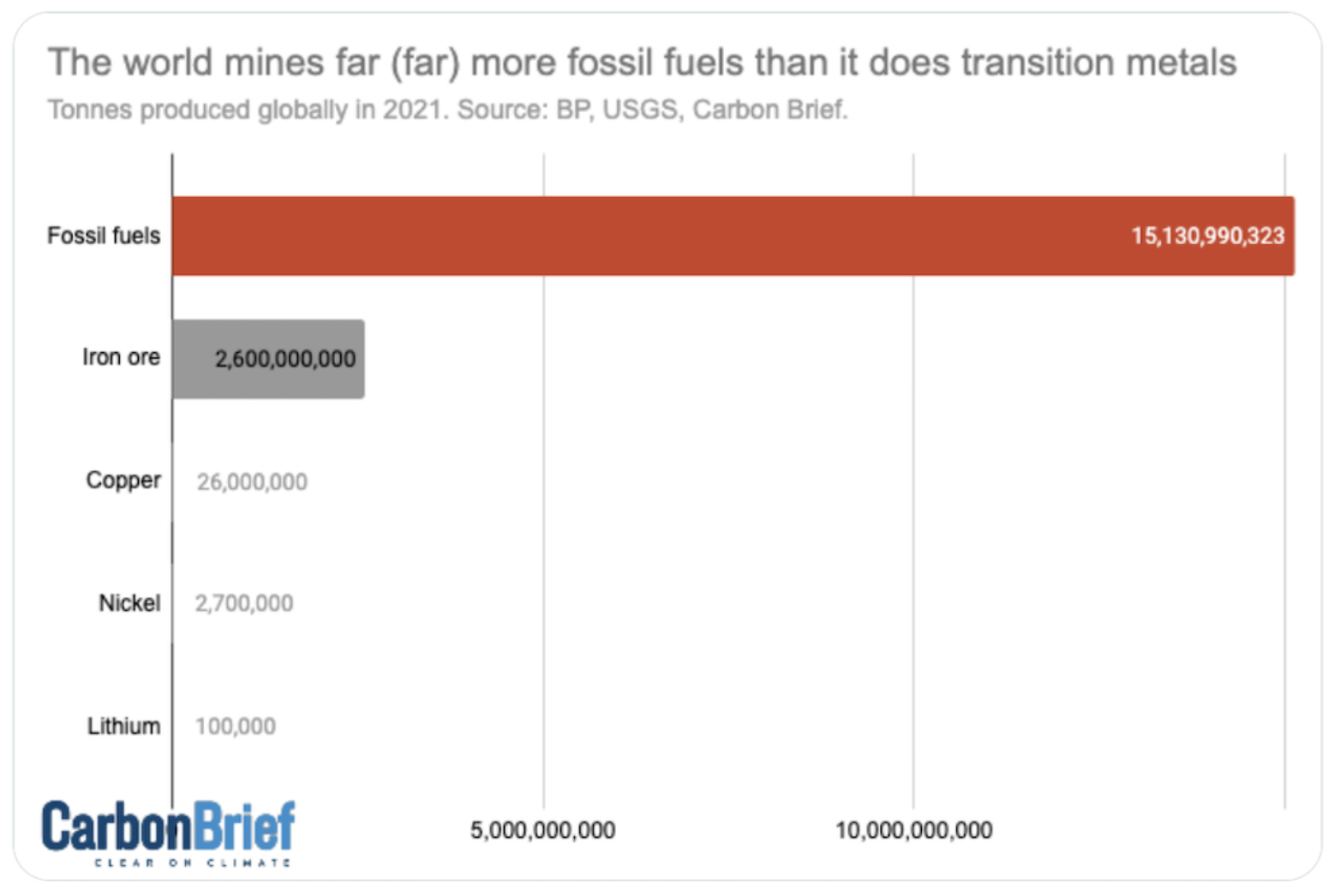
This is another category error that unfortunately Fressoz seems happy to go along with. The quantities of minerals required is minuscule compared with the huge tonnage of fossil fuels that has powered our carbon economy, as CarbonBrief illustrated as follows, as part of a debunking of 21 myths about Electric Vehicles [6]:

Credit: CarbonBrief

This false equivalence between minerals extraction and fossil fuels extraction is now widely shared by those who prefer memes to numbers.

A detailed published analysis of the demands for minerals required to build out renewables infrastructure by mid century shows we have enough to do this, without assuming high levels of recycling [7]:

“Our estimates of future power sector generation material requirements across a wide range of climate-energy scenarios highlight the need for greatly expanded production of certain commodities. However, we find that geological reserves should suffice to meet anticipated needs, and we also project climate impacts associated with the extraction and processing of these commodities to be marginal.”

Yet many commentators claim we are in danger of running out of ‘rare earths’ (which they conflate with minerals in general).

Beyond that, it is true that for many minerals it is cheaper to mine them rather than recycle them but Fressoz claims (p.218) “recycling will be difficult if not impossible”. There is no scientific basis for that claim. By 2050, one can expect that better design, improved technologies, economic incentives, and global coordination will become widely effective in tilting the balance to recycling rather than fresh extraction (and energy inputs to do this will not be an issue, as noted earlier).

And once you have built a wind farm it will continue to provide energy powered by the wind for a few decades (which is powered by the sun), without the need for material extraction or material inputs, and the faster this is done, the cheaper it gets, saving trillions of dollars [8]. 

A renewables circular economy is perfectly feasible, following the initial build out of the new infrastructure by mid century, with abundant energy from the sun powering the recycling needed to maintain and refresh that infrastructure.

Intermittency and grid stability

It is sad that Fressoz decides to play the it-doesn’t-always-shine card when he writes (p. 212):

“At the 2023 COP, the Chinese envoy explained that it was ‘unrealistic’ to completely eliminate fossil fuels which are used to maintain grid stability”.

… as though that settled the argument. They may have said this for UNFCCC (UN Framework Convention on Climate Change) negotiating reasons, but it is frankly pretty depressing that Fressoz shared this quote as though it reflected current informed opinion on power systems. 

Firstly, even fossil fuelled generation in the early 20th Century needed flywheels to level out energy supply, and in so doing, maintain grid frequency. Such devices can live on in a renewables dominated grid. More likely is the emergence of ‘grid forming inverter’ technology that can replace inertial forms of frequency response such as flywheels and turbines. 

Secondly, there are several other ways in which a grid that is 100% based on renewables can remain stable, including what is called ‘flexibility’ (including demand shifting), and distributed energy storage. 

The UK is rolling out a lot of battery storage, and these have the benefit of being able to be both large and small to support the network at local, regional and national levels. Battery Energy Storage System (BESS) technology is already making an impact in the UK, Australia and elsewhere [9] demonstrating the resilience that can be achieved in a well designed and well managed grid:

“Recently, a major interconnector trip sent the UK’s grid frequency plummeting. At around 8:47am on a morning in early October [2024], the NSL [North Sea Link] interconnector linking the UK and Norway, suddenly and with no warning, halted … with immediate and potentially disastrous impact on the UK’s electricity grid … battery energy storage systems (BESS) answered the call. Across NESO’s network [National Systems Energy Operator], 1.5GW of BESS assets came online to inject power into the system, bringing frequency to strong levels within two minutes.”

Far from renewables infrastructure causing a blackout, it prevented it. Other countries can learn from this (side eye to Spain!). 

A near 100% renewables grid is well within the reach of countries like Australia, and others are not far behind [10]

As the infrastructure scales up, additional storage will be added, to deal with rare extended periods of poor sunlight and low wind. The Royal Society has provided recommendations [11] on how to handle such extreme episodes. 

The Primary Energy Fallacy & Electrification

While Fressoz does talk about the efficiency arising from new forms of production and consumption, he does not really chose to provide any numbers (which is in stark contrast to the slew of numbers he uses when talking about wood, coal, oil, etc.).

He then makes the point (p. 214):

“In any case, electricity production accounts for only 40 per cent of emissions, and 40 per cent of this electricity is already decarbonised thanks to renewables and nuclear power.” 

He channels arguments that readers of Vaclav Smil will be familiar with. Telling us how hard it will be to decarbonise steel, fertiliser production, flying, etc.; no solutions, sorry. 

Even S-curves (that show how old technology is replaced by new) are disallowed in Fressoz’s narrative, because they are too optimistic, apparently, even though there is empirical evidence for their existence [12].

Just a ‘too hard’ message.

What he fails to mention is that the energy losses from using fossil fuels are so large that in electrifying the economy, we will need only about one third of primary energy hitherto needed (using renewables and nuclear). So, in the UK, if we needed 2,400 TWh (Terawatthours) of primary energy from fossil fuels, in an electrified economy powered by renewables, we’d only need 800 TWh to do the same tasks.

The efficiencies come both from power production, but also from end use efficiencies, notably transportation and heating. By moving to electric vehicles (trains, buses, cars) and heat pumps, we require only one third of the energy that has hitherto been used (from extracted coal, oil and gas). This is massive and transformational, not some minor efficiency improvement that can be shrugged off, as Fressoz does,

Green production of steel, cement and fertiliser is possible and in some cases already underway, although currently more expensive. Progress is being made, while flying is more difficult to crack. Together these sectors account for about a quarter of global emissions. Yet, road transport and heating together also represent about quarter of global emissions [13], and are easy to decarbonise, so I guess don’t fit into the book’s narrative. 

The surprise for many, who are effectively in thrall to the primary energy fallacy, is that we can raise up the development of those in need while not necessarily increasing the total energy footprint of humanity. We can do more and more, with less!

Who is deluded?

In his essay The Delusion of “No Energy Transition”: And How Renewables Can End Endless Energy Extraction, Nafeez M Ahmed offers an eloquent critique of Fressoz’s book [14].

A key observation Ahmed makes is that Fressoz’s use of aggregate numbers masks regional variations in a misleading way:

“Because he fails to acknowledge the implications of the fact that this growth is not uniform across the globe at all, but is concentrated in specific regions. The aggregate figures thus mask the real absolute declines in wood fuel use in some regions as compared to the rise in others. Which means that oil and wood fuel growth are not symbiotically entwined at all.”

Ahmed goes on to present the arguments about the different nature of the move to renewables, electrification of end-use and so on, in an eloquent and persuasive way. I strongly recommend it. 

Fressoz is right to claim that many have been seduced by a simplistic story about past transitions. His  book is very entertaining in puncturing these delusions, but he overplays his hand. Ahmed argues convincingly that Fressoz has failed to demonstrate that his methods and arguments apply to the current transition. 

Fressoz’s attempt to conjure up a new wave of symbiosis fails because he misunderstands and misrepresents the fundamentally different nature of renewables.

Is there a case for degrowth?

Of course, we do live in a world of over consumption and massive disparities in wealth (and over consumption does not seem to be a guarantee of happiness).

The famous Oxfam paper on Extreme Carbon Inequality from 2015 [15] showed how the top 10% of the world (in terms of income) were responsible for 50% of emissions, and the bottom 50% were responsible for 10% of emissions. An obscene asymmetry. As Kate Raworth argues in Doughnut Economics, we need to lift up those in need, while reducing the overconsumption of some that threaten planetary boundaries.

Yet we do not help those in poor countries by getting them hooked on fossil fuels. Indeed, renewables offer the opportunity to avoid the path taken by the so called ‘developed world’, and go straight to community-based renewable energy. This can be done – at least initially – without necessarily needing to build out a sophisticated grid: solar, wind, storage and electrified transport, heating and cooking is a transformative combination in any situation. We can increase the energy footprint of the poorest (providing them with the development they need), while reducing their carbon footprint.

Yet many want to play the zero sum game. True, there is a carbon budget (to remain below some notional global target rise in mean surface temperature, we cannot burn more than a quantity of carbon; the budget). We should share it out this dwindling budget fairly, but honestly, will we?

The game is nullified if people simply stop burning the stuff! The sun’s energy is functionally infinite (in any meaningful timeframe), so why not reframe the challenge? How about the poorest not waiting for, or relying on, the ‘haves’ suddenly getting a conscience and meeting their latest COP (Conference Of the Parties) promises? Countries like Kenya are already taking the lead [16].

Energy Independence and Resilience within our grasp

There are of course multiple interlocking crises (climate, nature, migration, water, and more). They are hard enough to deal with without claiming that energy should join them. 

The land use needed for our energy needs is small compared to what is needed for agriculture and nature, so again, renewable energy is not part of another fictitious zero sum game involving land use. 

A paper from the Smith School in Oxford [17] has found that wind and solar power could significantly exceed Britain’s energy needs. They found that even if one almost doubled the standard estimates of the energy needs (to cater for new demands such as circular economy, AI and synthetic meat in 2050), there were no issues with the area of land (or sea) required:

  • Solar PV 4% of British Rooftop
  • Solar PV 1% of British Land*
  • Wind Onshore 2.5% of British Land 
  • Wind Floating Offshore 4% of UK’s exclusive economic zone.

… and bearing in mind that 30% of land is currently used for grazing. 

The scare stories about prime arable land being covered in a sea of solar panels is politically motivated nonsense.

I gave a talk Greening Our Energy: How Soon, on how to understand how the UK has made the remarkable transition from a fossil fuel dominated energy sector to our current increasingly decarbonised grid, and how the journey will look going forward (and in a way that is accessible to lay people) [18].

In a world of petrostates and wars involving petrostates, there has indeed been repeated energy crises, and they will get worse while we remain addicted to fossil fuels.

Transitioning to a green energy future is the way out. It is already under way, we have the solutions. We just need to scale them up, and ignore the shills and naysayers.

Let’s not say or imply that solving the many injustices in the world is a pre-condition to addressing the energy transition.  This is the false dilemma that is often presented in one form or another, often from surprising quarters, including ostensibly green ones. It is a prescription for delay or inaction.

Achieving green energy independence and resilience might actually undermine the roots of many of those power structures that drive injustices, because energy underpins so much of what communities need: education, health, food, and more.

John Lennon seems to says it right in his song “Power to the people”.

© Richard W. Erskine, 25th June 2025

References

  1. More and More and More – An All-Consuming History of Energy, Jean-Baptiste Fressoz, Allen Lane, 3rd October 2024
  2. Historian Jean-Baptiste Fressoz: ‘Forget the energy transition: there never was one and there never will be one’, By Bart Grugeon Plana, Jorrit Smit, originally published by Resilience.org, December 2024, https://www.resilience.org/stories/2024-12-05/historian-jean-baptiste-fressoz-forget-the-energy-transition-there-never-was-one-and-there-never-will-be-one 
  3. Future of Earth, wikipedia, https://en.wikipedia.org/wiki/Future_of_Earth
  4. Energy: Engine of Evolution, Frank Niele, Shell Global Solutions, 2005
  5. The Fallacy of Perfection, Richard Erskine, essaysconcerning.com, 4th April 2024, https://essaysconcerning.com/2024/04/04/the-fallacy-of-perfection/
  6. Factcheck: 21 misleading myths about electric vehicles, Simon Evans CarbonBrief, 24th October 2023, https://www.carbonbrief.org/factcheck-21-misleading-myths-about-electric-vehicles/
  7. Future demand for electricity generation materials under different climate mitigation scenarios, Seaver Wang et al, Joule, Volume 7, Issue 2, 15 February 2023, Pages 309-332. https://www.sciencedirect.com/science/article/pii/S2542435123000016 
  8. Decarbonising the energy system by 2050 could save trillions – Oxford study, https://www.ox.ac.uk/news/2022-09-14-decarbonising-energy-system-2050-could-save-trillions-oxford-study 
  9. The role of BESS in keeping the lights on, Kit Million Ross, Solar Power Portal, 30th October 2024. https://www.solarpowerportal.co.uk/the-role-of-bess-in-keeping-the-lights-on/ 
  10. A near 100 per cent renewables grid is well within reach, and with little storage, David Osmond, Aug 24, 2022, https://reneweconomy.com.au/a-near-100-per-cent-renewables-grid-is-well-within-reach-and-with-little-storage/#google_vignette 
  11. Large-scale electricity storage, Royal Society, September 2023. https://royalsociety.org/-/media/policy/projects/large-scale-electricity-storage/large-scale-electricity-storage-policy-briefing.pdf  
  12. One in three UK car sales may be fully electric by end ‘23 as S-Curve transforms market, Ben Scott and Harry Benham, CarbonTracker, 5th January 2023. https://carbontracker.org/one-in-three-uk-car-sales-may-be-fully-electric-by-end-23-as-s-curve-transforms-market/ 
  13. Cars, planes, trains: where do CO₂ emissions from transport come from?, Our World In Data, https://ourworldindata.org/co2-emissions-from-transport (Our World In Data provides data on other sectors too).
  14. The Delusion of “No Energy Transition”: And How Renewables Can End Endless Energy Extraction, Nafeez M Ahmed, Age of Transformation, 24th April 2025, https://ageoftransformation.org/the-delusion-of-no-energy-transition-and-how-renewables-can-end-endless-energy-extraction/
  15. Extreme Carbon Inequality, OXFAM, 2015 https://www.oxfam.org.au/wp-content/uploads/2015/12/mb-extreme-carbon-inequality-021215-en-UPDATED.pdf 
  16. Doing development differently: How Kenya is rapidly emerging as Africa’s renewable energy superpower, Rapid Transition Alliance, 1 November 2022. https://rapidtransition.org/stories/doing-development-differently-how-kenya-is-rapidly-emerging-as-africas-renewable-energy-superpower/  
  17. Wind and solar power could significantly exceed Britain’s energy needs, Smith School of Enterprise and the Environment, Oxford University, https://www.ox.ac.uk/news/2023-09-26-wind-and-solar-power-could-significantly-exceed-britain-s-energy-needs
  18. Greening Our Energy: How Soon? Looking back and looking forward, to 2030 and beyond – A layperson’s guide, Richard Erskine, essays concerning.com, https://essaysconcerning.com/2024/12/21/greening-our-energy-how-soon-looking-back-and-looking-forward-to-2030-and-beyond-a-laypersons-guide/ 

2 Comments

Filed under Uncategorized

Apologists for Climate Greenwashing

Today, World Environment Day, the UN Secretary-General António Guterres made a special address on climate action “A Moment of Truth” in New York. In a speech that covered the impacts already being felt from the delays in taking action, and the injustices this gives rise to, he turned his ire on fossil fuel companies and their enablers (my emphasis):

“Fourth and finally, we must directly confront those in the fossil fuel industry who have shown relentless zeal for obstructing progress – over decades. Billions of dollars have been thrown at distorting the truth, deceiving the public, and sowing doubt. I thank the academics and the activists, the journalists and the whistleblowers, who have exposed those tactics – often at great personal and professional risk. I call on leaders in the fossil fuel industry to understand that if you are not in the fast lane to clean energy transformation, you are driving your business into a dead end – and taking us all with you. Last year, the oil and gas industry invested a measly 2.5 percent of its total capital spending on clean energy.”

He then went on to say:

“Many in the fossil fuel industry have shamelessly greenwashed, even as they have sought to delay climate action – with lobbying, legal threats, and massive ad campaigns. They have been aided and abetted by advertising and PR companies – Mad Men – remember the TV series – fuelling the madness. I call on these companies to stop acting as enablers to planetary destruction. Stop taking on new fossil fuel clients, from today, and set out plans to drop your existing ones. Fossil fuels are not only poisoning our planet – they’re toxic for your brand. Your sector is full of creative minds who are already mobilising around this cause. They are gravitating towards companies that are fighting for our planet – not trashing it. I also call on countries to act. Many governments restrict or prohibit advertising for products that harm human health – like tobacco. Some are now doing the same with fossil fuels. I urge every country to ban advertising from fossil fuel companies. And I urge news media and tech companies to stop taking fossil fuel advertising.”

The active disinformation has gone on for decades, as we well documented in the book, Merchants of Doubt, by historians Naomi Oreskes and Erik Conway (first published in 2010 https://www.merchantsofdoubt.org), and for which companies like Shell were active participants in climate science denial.

The on-going activities of organisations, individuals and PR companies funded by fossil fuel interests did not end in the mid 1990s (even <shocked emoji> in the UK), and has continued in many ways unabated, as Desmog has documented on an almost daily basis https://www.desmog.com. However, now the emphasis is on trying to undermine climate solutions, so as to justify carrying on using fossil fuels, either in electricity generation, or in end-use such as transport and heating. But as the alternatives are now so good, the PR and greenwashing has to be world-class to try to undermine them.

So it was astounding to hear Nick Butler – a Visiting Professor at King’s College – being interviewed on BBC Radio 4’s PM today (5th June 2024) by Evan Davis, being highly critical of the Secretary General’s speech. When asked about fossil fuel companies obstructing public discourse with their lobbying, public affairs, and so on, he said:

“… I think that was the case in the past but from the middle of the 1990s that has changed, certainly for the European companies, certainly BP and Shell, are going in a different direction …” <my jaw drops emoji>

Well being an ex-BP employee he would say that wouldn’t he. He is just one example of what might be called an apologist for climate greenwashing.

And it is incredibly disingenuous to say that adverts for oil and gas don’t appear on TV anymore in the UK. No, but adverts and PR for petrol powered SUVs, or Hydrogen Boilers, or … the list goes on. And to say that its all our fault for making the wrong choices, as Nick Butler suggested, is really the equivalent of victim blaming. I can’t take an EV Bus if there are no EV Buses (or indeed no bus service worth talking about), because car manufacturers and fossil fuel interests have been in cohoots to promote gas guzzlers (and are now whining because the China actually invested in an EV supply chain and market).

The truth is that between 2010 and 2018, Shell dedicated just 1% of its long terms investments to renewable energy, and paying creative agencies to target influencers to improve the brand’s image, etc, as Client Earth’s expose ‘The Greenwashing Files’ reveals. BP and the rest are no different.

You see they have moved on from the mid-1990s. Then the focus was on full front climate science denial, through a myriad of think tanks, influencers writing for the Daily Telegraph, Wall Street Journal, and wherever. Now they are more subtle, more devious. “Oh yes we love renewables”, they will say, but “when the wind doesn’t blow or it doesn’t shine our gas will be needed to generate your electricity”. Gas, I should stress, which they want to grow as a proportion of their business, not phase it out at all. It’s almost as if they are trying to gaslight renewables.

We have an example in the UK of fossil fuel interests – the gas network – producing hit pieces on heat pumps, and claiming that green hydrogen is better, even though all the science shows this is not the case (and in any case, its a ruse by them to carry on extracting natural gas to turn into hydrogen, which will never be green, because they will never be able to afford to bury the carbon dioxide produced in the process). Yet even the Bosch executive vice-president Stefan Thiel now accepts that hydrogen is a lost cause for heating homes. The delays caused by the industry’s disinformation campaign on just this one attack line has come at a cost – being delays in decarbonising UK home heating.

And the greenwashing has been getting worse as the fossil fuel companies try desperately not to be in possession of stranded fossil fuel assets. But they, and their PR / Advertising agencies, are now feeling the heat as one Desmog story Litigation Over Misleading Climate Claims Has ‘Exploded’ Over the Past Few Years reveals:

“Companies are increasingly facing legal action over their false or misleading climate communications, according to a new report examining trends in global climate litigation. That report, released late last week, highlighted a surge in litigation around climate-related greenwashing — what researchers have termed “climate-washing” — over the past few years.”

And to take Shell as an exemplar again, far from “going in a different direction”, as Nick Butler claimed, they are actually reducing investments in renewables because it does not “align” with their strategy to maximise extraction of methane (aka “natural” gas, see what they did there, long ago). They have been pulled up several times for misleading greenwashing advertisements.

As recently as 2022 Shell has had some of its adverts banned by the Advertising Standards Authority (ASA) for misleading claims about how clean its overall energy production is, as the BBC reported here.

One can forgive Evan Davis for not being as well briefed as he could be on the history and on-going tactics of the fossil fuel companies to delay the green transition through well funded PR, advertising and influencer campaigns, but it would not be a bad idea for BBC PM to do a follow-up with someone who is well informed.

For example, how about inviting Joana Setzer (Associate Professorial Research Fellow at the Grantham Research Institute on Climate Change and the Environment), and co-author of the report Global trends in climate change litigation: 2023 snapshot, as we know how much the BBC loves a bit of balance.

Richard W. Erskine, 2023

Leave a comment

Filed under Uncategorized

The Fallacy of Perfection

I was prompted to write this essay after listening to Justin Webb interviewing Ernest Scheyder (author of The War Below: lithium, Copper, and The Global Battle To Power Our Lives) on BBC Radio 4 Today on 3rd April 2024. I was impressed by the author’s arguments, stressing the need to make informed choices in the way we mine for minerals. I was however rather depressed by Justin Webb repeating talking points that are used by those trying to halt or delay the transition to clean energy. One thing Webb said rather illustrates my point:

“Is it also the case of us of us thinking whether we can find some other way of powering ourselves  in the future that doesn’t involve doing this, because I wonder if that’s what some people at least listening to this are thinking, just going from taking one out of the ground – oil – into taking another thing or another set of things just isn’t the answer, isn’t the long-term answer for the planet.”

The false equivalence between the extraction of fossil fuels and the extraction of minerals used in renewable technologies is so great (by a factor of between 100 and 1000), philosophers might call it a ‘category error’. I’ll get into the details below, but first I want to address the general issue of harms.

A reduction of harms

Imagine it is the 19th Century and it is proposed that workmen use poles with brushes to sweep chimneys in order to replace children going up chimneys. This is motivated by a need for a reduction in harms to children.

What would you think if someone said that chimney sweeps will harm birds nesting in chimneys and so we shouldn’t rush to replace children? A ridiculous argument, you may think, because it highlights the lesser harm without mentioning the greater harm that is being eliminated. 

But that is effectively how many argue against renewable technologies aimed at displacing fossil fuels. 

I call it the ‘Fallacy of Perfection’: the idea that any new solution should be developed to a point where it has no discernible short-comings before it can be scaled up to replace the old ways of doing things.

We see this most particularly with Electric Vehicles (EVs). There are numerous myths that are targeted at EVs (Carbon Brief have a Factcheck: 21 misleading myths about electric vehicles and a more succinct list here 10 EV Myths).

Perhaps the most popular and persistent of the myths relate to the mining of minerals needed for EVs and other renewable technologies. Like a meme that now floods social media, we hear that EVs are not green because of this or that, and the implication being we must find an alternative, or do nothing (which would please the fossil fuel companies – the planet, not so much). The naysayers are delaying getting to net zero which is time critical; it’s almost as if they do not take seriously the increasing impacts of man-made global warming!

The Carbon Brief Factsheet included the following graph: 

The harms done by fossil fuel extraction and use is the main cause of the climate and ecological crisis we face. 

EVs by contrast are like the birds nests being disrupted by a chimney sweep. There are issues to be resolved – and can be relatively easily – but using these issues as a reason to slow the displacement of fossil fuel use is a dangerous argument, that gives succour to those in climate denial.

The impacts from global warming gets worse in proportion to the cumulative emissions of greenhouse gases, most crucially carbon emissions from burning fossil fuels. Delaying getting to the point where we stop burning fossil fuels will only increase the harms that global warming is already causing. These will get worse with each year we keep emitting on the scale we are at present.

In this world, nothing comes with zero impact, and yes, mining for minerals needed for renewables comes with impacts, but we can choose to mitigate those impacts. But let’s get one thing clear, there is no shortage of the minerals we need to get to net zero. We do need to make choices on where we mine, and also the controls we put in place to minimise impacts, both ecological and social, as Ernest Scheyder makes clear. But we do not have the option not to mine at all, if we are serious about mitigating global warming!

But claiming EVs are uniquely problematic ignores the reality of the immediate impacts – such as from the huge spills of oil (Deepwater Horizon disaster for example) or the water pollution from tar sands, and much more – let alone the longer term ones.

People will need to travel in 2050, and whether it be on bikes, trains, trams, buses or cars, they are going to be mostly EVs (not Hydrogen Cell vehicles). So we need to use our ingenuity to electrify transport, and do it in the fairest way possible.

So let’s not use the fallacy of perfection as a reason for not rapidly decarbonising transport, that the World Bank has called the ‘low hanging fruit’ of decarbonisation.

Immediate impacts of fossil fuel mining

Fossil fuel extraction has immediate impacts that far outweigh the impacts from mineral extraction, in part because of their scale, as with the devastation caused by the Deepwater Horizon, or the pollution of the Niger delta, or the water issues cause by the Canadian Tar Sands mining, impacting people’s habitats and livelihoods, and the ecology. 

Long-term impacts of mining fossil fuels

Fossil fuels are extracted and burned once, but the carbon dioxide they release continues to cause warming of the planet for centuries. To power a fossil fuel economy you MUST keep extracting, and do so until you have exhausted all of that ancient carbon. You cannot reuse the coal, oil or gas once it is burned.

Long-term benefits of minerals for renewables

By contrast, minerals for renewable technologies are just the opposite. They are mined one, but are continuously used, enabling three things: 

Firstly, they enable us to use the energy of the sun to generate electricity to travel, heat our homes and much more. 

Secondly, these technologies ensure we  avoid the emissions we would otherwise make, and do this not once, but for the lifetime EV, heat pump or other end-use. 

Thirdly, we can then recycle the minerals. So, we have to keep extracting minerals till we have displaced all of the fossil fuel end-use, but once we have (and when recycling is more cost-effective or regulated to be so) we won’t need further mining. We get to a circular economy, because we’ll have enough in the system to reach a steady state of circularity.

We won’t run out of minerals

There is no shortage of the minerals we need to reach a global 2050 ‘net zero’ target. A detailed full life-cycle analysis of demand for minerals shows we can decarbonise our energy production and end-use without optimistic assumptions or modal changes in, for example, transport.

Yes, we have become too dependent on China, but the Earth’s crust provides more than enough.

We can clean up the supply chains

Yes there are some sources that have a poor environmental and ethical record. The solution is not to abandon a push to electrify transport. The solution is to clean up the supply chains. This can be done in a few ways.  Governments can legislate to require better management and monitoring of supply chains; consumers can choose EVs where the manufacturer is showing commitment to cleaning up the supply chain; and manufacturers themselves may simply make the moves necessary themselves. Tesla has done this (see their Impact Report), where they show they are committed to ensuring child and forced labour are not involved in materials they import.

Final thoughts

One has to wonder what are the underlying motivations, beliefs or biases that allow people to so easily pick up and repeat the myths and poor arguments that surround minerals and renewable technologies such as EVs.

Obviously, for the professional climate change deniers, they do it (whether they believe it or not) because they get well paid to write their odious pieces for The Teleggraph, Daily Mail and Wall Street Journal.

What is more puzzling is how often these memes are popular with those who would describe themselves as ‘green’. This is a conundrum that really needs a separate essay, but I think that at its root is a belief that ‘natural solutions’ and changes in society can deliver a greener future free from fossil fuels, with only minimal need to rely on that horrible technological stuff. 

This is a fantasy, even while natural solutions do have an important role to play, particularly in restoring nature.

Sometimes this belief is defended using some dodgy discredited ‘science’ about the potential impact of regenerative farming in terms of improved soil carbon sequestration (something I have touched on before in Fantasy Maths and the National Farmers Union). 

However in most cases I think it is a lack of appreciation of the urgency to stop burning fossil fuels, and the need to electrify much if not most of our energy end use as soon as possible, powered by renewable electricity generation.

All of us who strive to be green really do have to learn to love the technology, even while we insist on it being deployed in ways that do not perpetuate current injustices, and metaphorically and literally redistribute power.

(c) Richard W. Erskine, 2024

3 Comments

Filed under Uncategorized

How much energy could a community generate itself?

In a talk I addressed the topic ‘Greening Our Energy: How Soon?’, using recent research [1] to show that the UK could be self-sufficient in energy using wind and solar alone, along with significant levels of long-term energy storage to ensure energy security. The talk also discussed  how electrification of much of our energy use reduces the overall energy demand, something that Mackay and others have talked about for years.

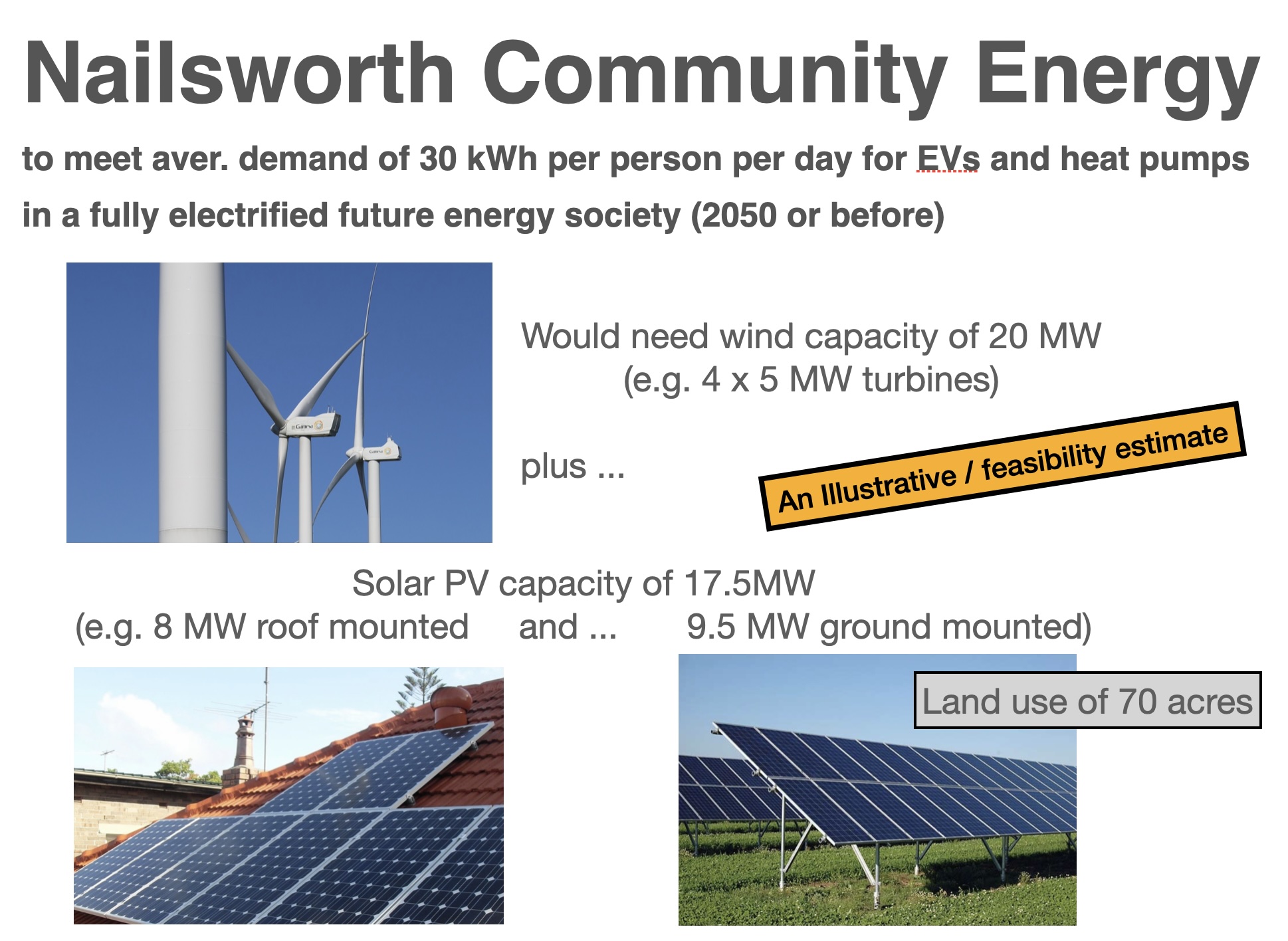
A question raised by an audience member was ‘How much energy could a community generate itself?’. This essay aims to answer this question, using my home town of Nailsworth as an example. As I said in the talk, the focus is on wind and solar.

When considering the total carbon emissions we are responsible for (so-called ‘consumption emissions’) studies [2] include literally everything. Including imported goods and produce. However, in terms of future UK generation, it is better to consider just the energy produced and consumed in the UK (the so-called ‘terrestrial emissions’).

We can narrow the scope further by considering those forms of energy consumption that are truly local and therefore best considered as being potentially met in whole or in part by community energy.

The two big ones are: 

  • electrified private cars and public transport (we’ll call these simply ‘transport’).
  • heat pumps used to heat our homes and offices.

In terms of carbon emissions, these two represent 60% of Nailsworth’s terrestrial emissions, and 40% of our consumption emissions, so highly significant, however they are viewed [2].

Credit: IMPACT: Community Carbon Footprint tool, Centre for Sustainable Energy (CSE)

According to Mackay [3], these would require energy consumption of 18 kWh and 12 kWh, respectively, per person per day in this electrified future world. The total including all energy needed would be 68 kWh/p.d and this is the figure used in the Oxford study referred to in my talk. So these two uses of energy would account for 44% of the total consumption of energy used.

The total of 30 kWh per person per day for transport and heating implies an average delivered power supply from community energy of 30/24 = 1.25 kW per person in Winter. In Summer we still need hot water but the great majority of heating is for space heating so we’d need about 12/24 = 0.5 kW per person in Summer for transport.

Nailsworth has a population of around 5,500, so let’s assume a future population of 6,000, which would imply a power supply required (for transport and heating) of 1.25 kW x 6,000 = 7,500 kW = 7.5MW in Winter, and 0.5 kW x 6,000 = 3,000 kW = 3MW in Summer.

Now the capacity factors for wind and solar in England [4]  are on average, respectively, about 40% and 3% in winter and 20% and 20% in summer.

The winter solar generation depends a great deal on the orientation of the panels – much more so than in summer. I have taken a relatively pessimistic figure, assuming on average East/West orientation, which still provides some energy in Winter but I have based estimates assuming wind alone meets the required demand in winter.

So let’s start with winter where we will discount solar [5]. Applying the capacity factor of 40% (in this case, dividing by 0.4) the 7.5 MW delivered energy would require 7.5MW/0.4 = 18.75MW of wind energy capacity to meet it. Let’s round that up to 20MW. 

For onshore wind turbines, we cannot use the largest ones available and are potentially restricted to say 5MW turbines. Only 4 of these would meet the power requirement of 20MW. Currently we have one 500kW wind turbine high above Nailsworth owned by Ecotricity.  Having established this precedent, and given changing public attitudes, and both Stroud District Council and Nailsworth Town Council having declared a climate emergency, one would hope this could be implemented, especially if it is a community energy scheme. 

Now, should we increase the capacity to deal with peaks in demand or lulls in wind? No, in my view. Community energy will be connected to the grid. When Nympsfield above Nailsworth is having a lull, other community sites around the country, and indeed large resources such as North Sea wind farms, will be able to take up the strain. 

A national energy storage strategy would deal with more extreme lulls that cover most of the country, as discussed in the talk.

Moving now to Summer, the four wind turbines proposed would deliver (now multiplying the wind capacity by the summer capacity factor), 20MWx0.2 = 4MW, so we’d need solar to deliver the remaining requirement of 7.5-4 = 3.5MW. Using the capacity factor for solar in Summer (at 20%, twice as good as the average for the year, 10%), that gives us a required solar PV capacity of 3.5MW/0.2 = 17.5MW. 

The average domestic solar PV installation in the UK has been 3.5kW, but with improved panels let’s round this to 4 kW. Assuming that the average home has 3 occupant, we anticipate 2,000 dwellings. They could provide a capacity of 2,000 x 4kW = 8MW, or about 45% of the solar capacity required. Yes, I know many live in flats, but the goal here is to look at broad brush feasibility. 

Ground mounted solar would then need to deliver 9.5MW. It’s been estimated that “Approximately 25 acres of land is required for every 5 megawatts (MW) of installation while 6 to 8 acres will be needed for a 1MW farm” [6]. So lets assume 1MW parcels at average of 7 acres each. We’d need 9.5 x 7 acres or about 70 acres. 

To give a sense of scale, Minchinhamption Common is 182 hectares or 450 acres, so we’d require the equivalent of 15% of it’s land area. This is not a proposal to use this common I should stress, just to give a sense of scale and feasibility. Nevertheless, shade (for our grazers and humans alike) will come at a premium by 2050 [7] so who knows?

This feels like a doable number.

To the extent to which domestic solar cannot be fully deployed, then ground mounted solar could be increased, or solar on commercial or civic buildings could take up the strain. I haven’t included these but they could make a substantial contribution (actually, are already making a contribution), albeit not necessarily being able to be classed as ‘community energy’.

The question naturally arises as to whether Nailsworth could use small hydro power using its streams, or as a mini Dinorwig, for energy storage, harking back to the Mill Ponds used during the 19th and 20th Century, when they provided some energy resilience to the wool mills of the town. It could of course play and role, and even if at a scale which is less significant numerically [8], could help in enabling local energy resilience [9]. There is strength in diversity, as nature teaches us.

Research on renewables offers up some pleasant surprises in how different forms of it can complement and support each other [10]. All of this is detail to explore of course.

My main goal in this essay was to establish if Community-based renewables – and specifically wind and solar – could compete in relevance with the large national assets such as North Sea wind, and thus provide a strong case for Community Energy schemes.

The answer is a definite yes.

Community Energy could provide a significant percentage (over 40%) of the terrestrial energy demand of a town like Nailsworth, throught the year. This would shift the control of energy, to a significant extent, away from large commercial assets, and could have untold benefits for local communities [11]. Nationally, such diversified and highly dispersed resources would enhance energy security for the whole country.

Richard Erskine, 6th March 2024

NOTES

[1] ‘Greening Our Energy: How Soon?’, Richard Erskine, Nailsworth Climate Action Network, https://www.nailsworthcan.org/blog/greening-our-energy-how-soon 

[2] IMPACT: Community Carbon Calculator, Centre for Sustainable Energy and the University of Exeter, https://impact-tool.org.uk/ 

[3] Mackay (2008), Sustainable Energy without the hot air, http://www.withouthotair.com/ 

3.1) Note that 68 kWh/p.d for a 70m population, say, in 2050 would amount to a UK energy demand per year of 68 kWh/p.d x 60m p x 365 d/y = 1,489 TWh/y – the total energy requirement that the Oxford Study shows can be achieved with wind and solar (actually, they show we could do double that quite feasibly with out excessive use of land or sea area).

3.2) Note that the (18+12)/68 = 0.44 or 44%

But be careful not to assume that means 44% of our consumption emissions being eliminated by transport and heating as it depends on the carbon intensity of different processes. It could be more or less. Actually, due to relatively efficiencies, moving to electrification of heating in particular and also transport, make very good contributions to displacing carbon-creating energy usage. As a percentage of our terrestrial emissions, transport and heating amount to about 60%.

[4] Estimating generation from Feed in Tariff installations, James Hemingway, DECC, December 2013, https://assets.publishing.service.gov.uk/government/uploads/system/uploads/attachment_data/file/266474/estimating_generation_from_fit_installations.pdf 

[5] For example, see https://leoht.co.uk/pages/how-much-do-solar-panels-generate-in-the-winter-  and also Sam Jeans, How much electricity will solar panels generate?, Federation of Master Builders, 6th November 2023, 

https://www.fmb.org.uk/homepicks/solar-panels/how-much-electricity-will-solar-panels-generate

[6] Everything You Need to Know About Solar Farm Requirements, Richard Burdett-Gardiner, 26th July 2023, The Renewable Energy Hub, https://www.renewableenergyhub.co.uk/blog/everything-you-need-to-know-about-solar-farm-requirements 

For ground mounted solar the area used has to take account of the spacing of tilted panels to allow for shadowing etc.

[7] Heatwaves such as those in 2022 will become much more common by 2050 on our current trajectory https://www.bbc.co.uk/news/science-environment-62207466 

So who know what solutions will be needed to provide shelter from the heat?

[8] I’m emotionally attracted to the gravitational storage / micro hydro idea. After all, the Mill Ponds around Nailsworth kept the mills running when the streams ran slack. It’s part of our history. But then again, Dunkirk Mill needed only about 16kW to run, a thousandth of what we are now considering, and even 20 of these would match the vastly greater energy footprint of modern society. The Centre for Alternative Energy’s Zero Carbon Britain report includes an estimate of 8 TWh of generation from hydro (including large and micro) for UK, so about 1% of the total.

[9] Assuming 20 reservoirs at 100m above their twins on valley floor, each holding 10,000 cubic metres of water, and a round trip efficiency of 75%, one could store about 40 MWh of energy, a not inconsiderable amount. If each reservoir used a 100 kW turbine (not the largest micro turbine but illustrative) then they would generate in total 2 MW, or nearly 30% of the Nailsworth average power demand, although at full power, the reservoirs would be exhausted in 20 hours. If larger turbines were used, the duration at full power would decline in proportion (eg. if 500 kW, then in 4 hours)

For storage, Micro hydro would have to compete with (or maybe, collaborate with!) domestic or small scale batteries. For example, if each household had a battery with 100kWh storage, then 2000 of these would equal 200 MWh, and would be equivalent to 200MWh/7.5MW = 26.7h, so about 1 day’s worth of storage. That again is pretty significant local resilience to augment a national massive (30 day) storage capacity discussed in the essay.

[10] While either micro hydro or batteries may have limited capacity, they could make an extremely significant contribution to balancing the local grid over a day or so, and that could in its turn relieve pinch points in the distribution grid when there are short term mis-matches between supply and demand. Indeed, I wrote a piece – Small Is Beautiful – local renewables and storage can catalyse the greening of grid – based on some modelling in the USA that showed that even small amounts of local solar could have a disproportionately large impact in enabling increasing grid-scale wind resources. Similar modelling of a diverse array of renewable assets could reveal other pleasant surprises.

[11] A Community Energy scheme could, if setup right, ensure that it incorporates energy security for all as a founding principle, using profits to help fund the restrofitting (insulation, solar, heat pumps, etc.) of poorly built or maintained accommodation and social housing, for example.

THE END

5 Comments

Filed under Uncategorized

Heat pumps conspiring to keep EV drivers snug in snow drifts, whatever next!?

There are no shortage of myths and memes that attack EVs and Heat Pumps, particularly in the pages of The Telegraph and other right wing outlets. It’s a curious phenomenon, railing against thermodyanmics.

There is of course an inevitable transition to a clean, electrified and decarbonised world. The goal of naysayers is not to stop it happening (they are not that silly), merely to delay the inevitable for as long as possible. That’s what the fossil fuel lobby wants to achieve – wringing out as many dollars as they can before the bubble bursts; before assets are stranded.

There are several myths about EVs and Heat Pumps that are widely shared. These have been refuted many times, such as in these plain English pieces on the Nailsworth Climate Action Network website: myths about EVs and myths about heat pumps.

One I hadn’t seen before popped up on my social media timeline. It suggested that if EVs got caught out in a snowdrift, the batteries would get cold, so couldn’t work, and occupants would freeze, whereas those in petrol/diesel cars would be OK with their idling fossil fuel powered engines.

I can imagine The Telegraph readers – fed on a daily diet of hit jobs on any clean tech – chuckling at the idea of EVs freezing up in the snow.

The truth is quite the opposite. This meme is just another lie powering another social media storm; another myth to add to a growing list. Reuters provides a great factcheck refuting the points being shared widely across social media. Reuters quoted Professor David Howey from the University of Oxford’s Department of Engineering Science:

“Electric vehicles use very little power when stationary … the motor doesn’t consume power at zero speed … only the car electronics and heating/cooling systems use power when the car is stationary, and the amounts are relatively small … [and could run climate settings for] at least a day, probably many days”

Dr Katherine Collett, was also quoted, saying of EVs that “Many of them are installed with very efficient heating systems nowadays” 

But it gets better, because the “very efficient heating system” being referred to is – hold onto your hats – a heat pump. This means that both the car’s battery and car interior are kept snug by a heat pump; and just as for home heating, that means electrical supply stretches further. A heat pump can turn one unit of electrical energy (in an EVs case, from a battery) into a few units of heat energy, as explained here. If you had a resistive heater for the EV that would keep you warm for so many hours [1], with the heat pump it could be 3 times as long that you would stay warm.

The efficiency of EVs and Heat Pumps, and the future-proofing that electrification enables, means that The Future Is Electric.

This will all probably make The Telegraph readers heads explode.

Their bete noirs – EVs and heat pumps – are now conspiring to keep EV drivers snug in snow drifts long after the petrol heads have started to freeze because their fuel has run out.

Stuck in a storm of disinformation about EVs and heat pumps, this is the perfect cautionary tale on what not to believe, for those who have been misled by a right wing propaganda machine. A machine in part funded by fossil fuel interests and in part motivated by misplaced culture wars ideology.

My advice is, don’t get caught in yet another bullshitstorm of disinformation, get off social media and the papers, and hunt down genuine experts. They’re not exactly hard to find.

(c) Richard W. Erskine, 2023

Notes

[1] In one test an older Tesla that had resistive power heater (so not with a heat pump) and at about -10C, it was found that “No surprise, but the Tesla is vastly more efficient, burning 1.6 kWh per hour versus the Hyundai sucking gas at the rate of 10.3 kWh per hour”, and both the Tesla (2019) and Hyundai were able to maintain a comfortable internal tem[erature for nearly 2 days .

1 Comment

Filed under Uncategorized